There are some things in life that will always keep this planet a house divided.
Many of humanity's thousands of cultural wedges are petty and cause us to simply chide and tease each other: Coke vs. Pepsi, Iowa vs. Iowa State, the chicken vs. the egg. Others lead us to take up arms: pro-life vs. pro-choice, Israel vs. Palestine, Shiite vs Sunni.
And then there are those culturally-constructed hurdles that we can laugh and joke about when we find them in our way, but leave us nonetheless frustrated when we struggle to get over them. They are not so serious as to make us want to kill each other, but there are times when they can make even the most sensitive cultural-relativist harbor an ethnocentric thought or two. In a nutshell, whatever leads to a feeling of culture shock falls under this category.
Between Brazilians and Gringos there are several such barriers that make cultural rapprochement difficult if not virtually impossible. I plan to focus the next several posts on such impediments, starting today with one of the most evident: time.
The snag lies in our respective appraisals of a minute. We manic Americans inflate a minute's value. "Time is money" is the metaphor we live by. We "spend time" with friends. We "budget our time," lest we "waste it," and the most expensive of all minutes to spend or waste is a New York one.
In Brazil, you "passa tempo" (pass time), as if the act of moving from one minute to the next were as natural as breathing, and time itself as abundant as air. Indeed, for those looking for the antidote to the New York minute, Brazil in general, and the state of Bahia in particular, is the place to go. Two years ago when I studied in the city of Salvador (in Bahia) a bunch of us students ordered a round of beers at a bar on an island that our program was spending the weekend at. The entire island had been in a blackout all day (not a rare occurrence we found out), and we begged the server to find us some cold beers, not expecting at all that they would even exist due to the power outage. "Um minuto baiano," he lilted in reply, "Just a Bahian minute." About 10 minutes later we got our beers. And yes, amazingly, they were cold.
Good things come to those who wait. An axiom for cultural reconciliation?
In the U.S., everything starts when we say it starts: classes, work shifts, events, the end of happy hour. (The one exception of course is that bohemian jazz hole in every major city where a gig always starts 30 minutes late or more.) We get marked tardy if we arrive to class so much as 5 minutes late, and now businesses have made computers that will prevent a cubicle-dweller from logging in if she doesn't do it by 8am sharp. Should she get to her desk at 8:05, she'll have to confront her supervisor, who will log her in using a special supervisor's password before writing her up for being late to work.
In Brazil, on the other hand, your 7am class won't start until 7:15 on average, and some professors may not even show up until 7:30. A party doesn't start at 9:00, rather more like 10:00 or 10:15. This extra allotment (whoa, easy there, metaphor!) of time functions as something of a cushion, allowing people to collectively move relaxedly from one place and time to another in healthy accordance with their customary pace, as well as accounting for any unforeseen obstacles that could arise: traffic jams, running into an old friend, etc. This custom is not necessarily a conscious action. Sometimes Brazilians just lose track of time completely. One night I was out with Ricardo and some friends, and by the time midnight rolled around Ricardo turned to me and asked, "Hey Brett, what time is it?" When I told him midnight he was shocked that it wasn't in fact 11:00 as his internal clock had presumed.
Yet Brazilian tempo isn't uniform across the whole fabric of society, and this disparity can lead to conflict. Buses are a good example. A city bus in Belo Horizonte will follow its itinerary to the minute. During the week this isn't that big of an issue; if you miss your 8:10 bus due to an unhurried breakfast, you can still catch another in the next 8 to 15 minutes. On weekends, however, many buses only pass by certain stops once or twice an hour, behooving Brazilians to put a little more pep in their step, which can prove a to be struggle, as I experienced on a Saturday evening a little over a month ago.
Five friends and I had decided to go see a movie downtown (movies also are exempt from adhering to Brazilian time), and the only bus that would take us from near my apartment to the movie theater passed by only once every half hour. Approaching the time when the last bus that would get us to the theater on time was to pass by, my Brazilian friends were still lounging around, watching TV and chatting. I had to play the part of the annoying American: "We're gonna have to leave in 5 minutes," I announced to everyone. Really it was more like 10, but I adjusted accordingly. My friends got up leisurely and declared their need to brush their teeth and go to the bathroom before heading out. One friend casually talked to his brother while brushing his teeth, making the process last almost the entire 5 minutes I had "afforded" him (there's that metaphor again...). Finally walking out the door with what I thought was about a minute to spare before the bus would come - and with a 3 minute walk to the bus stop ahead of us - I seemed to be the only one worried that we would miss the bus and thus miss the movie. As it turned out, the bus arrived about 10 seconds after we did, and to my carefree friends it was as if this stroke of sheer luck was ordained by the natural and proper flow of time. Had we arrived 20 seconds later, it wouldn't have been our fault. "We were just following our natural rhythm; it's the bus company's fault for not offering more buses on a Saturday," my friends would have complained.
One would think that after a little over 7 months living amid this climate I would have grown accustomed to it. I sort of have. Old cultural customs are hard to break. Gringoisms still dominate my identity, preventing full Brazilianization. Take this past weekend for example.
Sunday, September 7th, Brazil celebrated its 186th Independence Day. My friend Adriano and I had planned to meet up downtown in the morning to take in the parade commemorating the holiday. Adriano told me to meet him at 8:30, which, of course, meant something closer to 8:45 or 9:00, said my Brazilianized side. Working backward from 8:45 or 9:00, my Gringo side came up with the following plan: Of the 4 buses that I could take from my neighborhood to downtown, I would have to find out which one stopped a few blocks from my place between 8:15 and 8:30, as the trip would take 30 to 40 minutes depending on the route (there it is again... for us trips take time, for Brazilians they demora (last) time). I consulted a timetable online and found the perfect plan: Bus 4111, stopping at 8:20, 35 minute ride. Brilliant!
In very Gringo fashion I left the apartment that morning at 8:10, giving myself plenty of time (yet again...) just to be sure I didn't miss my bus. It just so happened that as I was walking out of the entrance to my building, I saw the Sunday edition of the Estado de Minas newspaper lying on my neighbor's doorstep, and on the front page was an article about foreigners living in Minas Gerais. My impulsiveness kicked in; I just had to buy a copy and read about how my fellow foreign brethren were faring here. The nearest banco de jornal (kiosks on the street that sell a variety of newspapers and magazines) was about twice as far away as the nearest bus stop, yet it itself was only half a block from the next nearest stop. I calculated on the spot that I had enough time (...) to walk to the kiosk (6 or 7 minutes), pick up a paper, and walk to the nearby stop in time to catch Bus 4111.
By the time I got to the banco my watch read 8:18. I approached the owner of the stand, a short, squat, hunchbacked man with a scrunched face and dark yet graying comb-over, as he was undoing bundles of the day's newspapers: Folha de São Paulo, O Tempo, Super, and of course, "Um Estado de Minas por favor!"
"Um momentinho," came the little man's reply. Or at least that's how I perceived his mumbly , heavier-than-normal Mineiro accent. He proceeded to slowly lift up one bundle after another, read the invoice, comment on something incredulous about it, and arrange the papers on his stacks. I looked at my watch. 8:19. Within a few minutes 4111 would pass by, and although I was within 100 feet of the stop, I wouldn't be able to see the bus until it had continued on its way due to a building blocking my view of the stop. In other words, I wouldn't be able to wait for 1) my little friend to sell me a paper, or 2) the bus to show itself and prompt me to ditch the effort at the last second and run to catch it. I tried to take control of the situation:
"Could you just grab an Estado de Minas for me please? I'm kind of in a hurry to catch my bus."
In Brazil, "hurry" is a dirty word. Using it was a last resort. The little man shot a glance at me, shook his head, shrugged, and said something in completely unintelligible mineirês. Probably something to the effect of, "I'm going as fast as I can, let me do my job, I've been doing this the exact same way for years, you ain't gonna change me, missing the bus is your problem." I looked at my watch again. 8:20. If I bailed now the worst that would happen would be my not having a paper to read on the 40-minute bus ride, a paper that I could always pick up later. If I waited another minute, I risked missing the bus, a good chunk of the parade, and having an even grumpier newspaper stand owner on my hands. I gringoed out, erring on the side of caution. "Obrigado," I said, "I'll stop by later." An unintelligible goodbye shot back as I was already walking away.
Astonishingly, the bus didn't come for another 5 minutes. Thus, I probably could've waited for my paper, but then again, hindsight is 20-20.
Instead of reading about foreigners living in Minas, I used the 40-minute trip (one last metaphor sighting) to reflect on the life of this particular foreigner and what had just happened to him over the course of the last 5 minutes, the last hour, the last 7 months. In the U.S., treating a customer as this newspaper stand owner had treated me would be the first ticket to losing your newspaper stand. Time is money. Asking a customer to wait on you for the sake of routine amounts to wasting time, wasting money. Yet maybe there's something to be said about routine; if routine means following a healthy rhythm of life, and a healthy rhythm of life leads to greater longevity, then perhaps my not receiving my paper that morning was a good thing for reasons greater than that very moment: this man would live longer, he and his friends and family would be happier, as would the friends and family of his friends and family, and so on and so forth. Strange logic? Fuzzy math? Definitely. Such a philosophy is as foreign to us Americans as eating large lunches of meat, rice and beans and taking a sesta (Portuguese for siesta) afterward - we'd be wasting time eating anything more than a sandwich, an apple, a Coke and some chips, which would only keep us from stoically withstanding our 30-minute or hour-long lunch breaks. In Brazil, such cultural behavior may not be good for business, but it preserves the fabric of Brazilian society as well as (and perhaps better than?) our on-demand culture preserves ours.
As for my elaborate plan this morning, it was further proof that any Brazilianization of my Gringo mind was hopeless. While I had adapted to the habits of my hosts, it was that adaptation itself - or rather my particular calculating way of adapting - that kept me from truly being baptized Brazilian. To be perfectly native, I'd have to leave the house at 8:30 and show up at the bus stop with the vague hope that the right bus would soon come. If it didn't, I'd take solace knowing that one would come eventually, and that I'd get there when I got there.
I won't lie, I've missed American efficiency over the last 7 months. Following the like-clockwork rhythm of society, as if you yourself were a sprocket in the works, may seem cold and inhuman, especially after living this long outside of it. Yet that is my home, and I could never be parted from it.
I think we've reached the time when the sterility of pure post-modern cultural relativism has become fruitless and inutile. We can deconstruct a culture and say that it's different from ours because of x, y, and z. But to what end? To simply be satisfied with the knowledge that it's different? Maybe academics can afford that luxury, but the rest of us need to understand that in this ever more connected world there is so much we can not only learn from one another, but allow to change one another for the sake of improving our own societies and strengthening the ties that bind one culture to the next. It would be easy for us Americans to say that Brazilians need to respect the value of a minute if they ever hope to advance economically to our level. I'm not going to deny that that's not true. But what we haughty Americans must also do is respect the Brazilian value of a minute. The efficiency of our society doesn't have to come with a more stressful marking of time, nor the heart disease that follows. Does that mean allowing students to show up late to class should they choose? Not necessarily. If anything, we show up on time for class out of respect more for education than for the sake of being on time. What I believe we can take from the Brazilian concept of time is the ability to laugh and be happy even when efficiency breaks down. When traffic makes us late for work. When it takes us a minute longer than normal to get our morning pick-me-up from our local coffeeshop. We shouldn't get mad at ourselves when finishing the last page of that gripping novel makes us miss our bus and "sets us back" 15 minutes.
Time may indeed be money. But it can be so much more. It can be the key to a happier, healthier life, if used wisely. If used Brazilianly.
Tuesday, September 9, 2008

Friday, August 29, 2008
Projeto Rondon
The town of Jeribá is little more than a large cursive ‘T’ on the face of the planet. A main arterial dirt road connects the top of the ‘T’ with Dois de Abril to the east and Palmópolis to the west. The trunk of the ‘T’ is a 15%-or-so grade hill (i.e. pretty darn steep) paved with jagged cobblestones, linking the “center” of Jeribá at the bottom with its school at the top. Even from halfway up, the view from the hill is breathtaking: mile after mile of rolling green mounds, too small to be called mountains, too large to be hills. Further off to the north, a trio of giant odd-shaped rocks juts out to reign over the landscape. In the late afternoon, when the sun gives off its daily hour of rich, soft, indirect light, the view becomes ten times more photogenic.

Just before the 5:30pm Brazilian winter sunset, our band of 16 “Rondonistas” left an afternoon of sex ed classes for adolescents and general health classes for Jeribá’s elderly at the school at the summit and headed downhill toward our modest lodging for the day near the intersection of Jeribá’s ‘T’. The deep azure sky specked with orange and purple clouds hovering over an ever-darkening terrain made us pull out our cameras and capture what would be our last sunset in Jeribá.

What a spectacular view this town is blessed with.
That was my first thought. A strange thought at that for a town that has next to nothing, that sustains itself (barely) through small-time agriculture and exporting workers to the industries of São Paulo or Belo Horizonte. Jeribá isn’t even a town; it, along with its sister Dois de Abril, is a mere district of Palmópolis, a metropolis in microcosm. All political and virtually all of the scant economic power is concentrated in this latter town of 7 or 8 thousand, 10 times larger than satellite Jeribá and 4 times that of Dois de Abril.
As the countryside grew darker, so too did the luster of the view from Jeribá’s hill. My mind drifted to earlier that morning. There, after several hours of fun and games with Jeribá’s kids at the school, 9-year-old Débora, her hair shorn like a boy's to a mere couple of inches because of a bout of head lice, remarked how hungry she was. A fellow Rondonista told her not to worry, she’d be heading home soon for lunch. Débora sadly replied, “But there’s no food at home.” The image of this poor girl walking up Jeribá’s enormous hill on an empty stomach, only to find a school with only so much potential to enrich her mind and classmates only too eager to make fun of her haircut that would be beautiful anywhere else in the world but traditional rural Brazil, made the view from the top of the hill at once turn ugly. What if Jeribaenses never even bothered to spend a few seconds of their day to take in the vista? Who’s to say they didn’t deliberately ignore it, seeing it as a curse, beauty forever mocking their plight? Who were we to suddenly gain the right to appropriate this view in little digital boxes?
How did we get so lucky to be the ones wearing the T-shirts with "Projeto Rondon" written on them, taking views like Jeribá's as a sort of "payment" for our volunteerism?
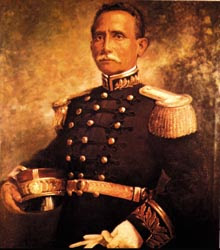 The Projeto Rondon is named after Brazilian Army Marshall Cândido Rondon, whose life and mission spanned the 19th and 20th centuries. Rondon, of indigenous descent, is renowned for his many explorations of the Brazilian hinterland—including a famous expedition to the Amazon with U.S. President Teddy Roosevelt in 1914—to get to know Brazil’s numerous indigenous tribes and help to integrate them into modern Brazilian society. One of his mottos, used today by the Projeto, was “Integrar para não entregar,” “Integrate, don’t give up.” Give up a people, give up a land, give up the dream of a country united in its forward march marked by order and progress.
The first time university students were sent in Rondon's footsteps to better understand their diverse, continent-sized country was in July of 1967, when 30 such students from Rio were flown by military aircraft to (appropriately) Rondônia, the western Brazilian state named after Rondon whose inhabitants live isolated behind the curtain of the Amazon Rainforest. Further joint university-military missions (keep in mind this was at the height of military rule in Brazil, which lasted from 1964-1985) continued sporadically until the mid-70s, when the Projeto was lost to the ever-changing and always tense political atmosphere of the military state. Further missions of integration would have to be made under other auspices until the Projeto Rondon was officially revived in 2003, the first students intervening in January of 2005 in the town of Tabatinga, located on the border with Colombia in far western Amazonas state.
The present-day Projeto continues Rondon's goal of integrating the far-flung peoples of Brazil. The Projeto's flagship programs are found at the national level, where students from the developed southern and southeastern regions of the country connect with their compatriots in the less developed northeast and north. Teams are made up of students from a range of "majors" (to use American terminology), and through a variety of workshops these teams share their collective knowledge and experience with health, literacy, business, valuing and preserving culture, leadership skills, and much more with targeted communities.
But these communities aren't limited to those hidden in the rainforest a thousand miles away from the sands of Ipanema or the hustle and bustle of the Avenida Paulista. Even within the most well-developed states in Brazil's southern half, dozens of poor, rural municipalities exist far outside the orbit of an industrialized metropolis. Thus the need for the Projeto at the state level.
The first interventions in Minas Gerais embarked in July of 2005 for communities with Human Development Indexes under 0.7. Interventions followed in December of 2005, and July and December of 2006, and this year-and-a-half span saw over 1,800 PUC students, educators and staff members bring the project to 53 Mineiro communities, touching the lives of between 50,000 and 60,000 people per trip. Ventures have continued semi-annually since.
I first found out about the Projeto Rondon at an informal get-together for PUC's international students all the way back in February, where a woman involved in the Projeto's administration gave a short presentation. It took about a month for my piqued interest to turn into action. Feeling that my time on this Rotary Ambassadorial Scholarship was lacking a service side to its ambassadorialship, I decided to attend a more detailed informational meeting. Alongside about 500 fellow PUC students, I became sold on the Projeto's mission of bringing integration and solidarity to rural Minas, and the opportunity it offered me to get to see a side of Brazil that I would otherwise never have seen.
After sacrificing 6 of our Saturday afternoons throughout the Brazilian fall semester to prepare for our two weeks as Rondonistas through a series drudging workshops, teams of around 15 students and a coordinator were assembled literally on the eve of departure. For our team of 16, the first few hours on a winding 14-hour bus ride had to suffice for introductions and first impressions before everyone leaned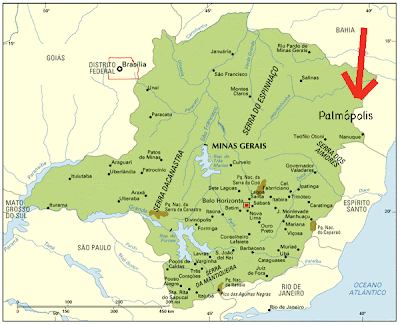 their seats back and tried to catch a few uncomfortable winks. Our team comprised of PUC students from health sciences to social sciences, biology and psychology, engineering and law. The youngest was an 18-year-old freshman, the oldest our coordinator Ana Luísa, a recent PUC grad in psychology and a mere 25. Our destination: Palmópolis, a rural community in the northeast corner of Minas Gerais that was officially established as a municipality in 1992, finally giving its inhabitants, mainly temporarily contracted workers in cattle fields and banana groves, a place on the map. Palmópolis, along with other targeted communities, was chosen for its low HDI score: 0.615. What does that mean? Palmópolis is closer to “less developed” than “highly developed” for a variety of reasons: poor education, lack of basic infrastructure, low GDP per capita, limited access to healthcare, among others.
 Ana Luísa had been a Rondonista in Palmópolis before, and after graduating college she lived and worked there for nearly a year. Her experience in Palmópolis, particularly her contacts with those in positions of power, proved invaluable. In a country where mobility is based far more on who you know than what you know, her tireless efforts to talk with just the person who could facilitate our every action made the difference, in my mind, between a successful mission and a potential failure.
 Weary from lack of sleep and bruised from every bump of the final three hours of the ride on a dirt road, we nonetheless donned brightly colored costumes and, like a band of traveling minstrels, paraded through the streets of Palmópolis singing, banging drums, and making our presence known. After about an hour, children began to follow us a la the Pied Piper toward the main plaza, at which point songs and games ensued. After a few hours of singing and playing, more tired than at any point so far that day, we headed back to our headquarters, a social services shelter with Spartan facilities, and wrapped up the day with a series of meetings to prepare for the days ahead, as well as “get-to-know-each-other” games that made up for what was lacking in several waking hours on a bus. We ate our first of two weeks’ worth of delicious, home-cooked, natural and organic meals that we’d wolf down ravenously, and then fell asleep together on the same hard, cold, tiled floor almost the very second we laid prostrate on our inch-thick mats.
Days two and three involved walking up and down the sinuous, spaghetti-bowl streets of Palmópolis, knocking on doors and taking surveys of the town’s inhabitants regarding their access to basic utilities and their monthly income. Only a handful, we found, had no electricity. Slightly a few more had no running water, and hardly anyone enjoyed a sanitary sewage system. As for monthly income, the highest recorded was around 3000 reais (~$1800), belonging to a local government minister (the mayor was unavailable for interview—surely his would have broken this mark). The lowest was around 60 reais (~$38), from a widow who cooked the rice and beans bought with this pension check with water from the river, the same river that acted as the local sewer and laundromat.
More than once, the divide between “developed” interviewers and “developing” interviewees became cause for the latter to lash out at us with an indignant “what are you doing here?”, or “we have nothing here, and how are you going to help us out?”. Near the end of each day, our band would meet for an hour to decompress from dozens of interviews, share our perspectives of the town, and tie tighter the bonds we had been continuing to weave together. The evening would be capped off—as would be the case for the remainder of our days as Rondonistas—with a three-hour-long rotation to take a much-coveted shower.
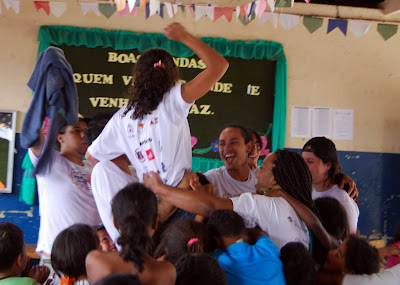
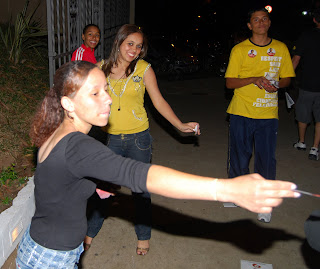
 On day 4, a Thursday, our interaction with the people of Palmópolis began in earnest. The morning began with a series of games at the local school: soccer, hopscotch, peteca (an indigenous game played like badminton, only you use your hands, see photo at left), and, an American classic, tossing around a Frisbee. In one of the last games, played mainly with smaller children, the de facto motto of our intervention was born: “Todo mundo ganhou!” “Everybody wins!”
Our hope with the morning of games was to rile the kids of Palmópolis up enough so that they’d be somewhat calm for more serious activities in the afternoon: talks about familial relations and storytelling and literacy activities. Not to be. The same kids from the morning were twice as rambunctious, chasing each other and climbing trees and distracting those few who wanted to participate. From American eyes, it suddenly became easy to see where lay the roots of a society that has minimal respect for law and where discipline is toothless. Meanwhile, a second contingent of our team was working with Palmópolis’ elderly on how to properly exercise in their twilight years. In our meeting later that evening the discussions generated by both halves of the team revealed yet another divide taking place all over Brazilian society—really, all over the world: the age divide. Kids solely seeking new and better means for stimulation have no patience for the repositories of wisdom, traditions and values, stories of a hard yet glory-filled past. What would the wild and crazy kids from today’s activities have to tell their grandkids 60 years from now? How they ran around and hit each other, then went home and watched cartoons?
 The morning of day 5 introduced us to a group of kids in whom seeds of tradition were being carefully planted. Our planned activity for the morning was to show a film for the kids of Palmópolis, with the objectives being to 1) pull kids off the streets, and 2) give less fortunate children the opportunity to see a movie they may never have the chance to see. The movie: The Incredibles. The locale: Palmópolis’ Casa da Cultura, the House of Culture. There, along with a handful of kids we had coaxed from kicking dirt in the street, we bore witness to one of the bright spots of the town: the children’s Afro-Dance and Capoeira (a Brazilian martial art) class. We let the class continue for an hour or so, about half its normal time, and even participated in some of the dance steps and percussion. At the end of the class, after the 20 or so kids had gracefully flowed through dance after dance, the three teachers had the chorus of students shout out the class rules:
1. Respect your teachers
2. Respect your classmates
3. Don’t fight
4. Don’t skip class
5. Respect all the mestres (Capoeira masters) that came before you
I wonder if one of these kids will grow up to write the book "Everything I Every Need to Know, I Learned in Afro-Dance Class."
The class went to wash up, and then came back and sat down to watch the movie. The transition seemed all too strange. Don’t get me wrong, The Incredibles is a fantastic movie, and I do believe showing it had the potential to expand the budding imaginations of all the kids in that room. But to cut into a class that taught these kids the values of their own cultural heritage, only to show them a film that had nothing to do with their lives, that didn’t teach them order and respect, it seemed terribly out of place. Marx would call it alienation of one culture by another. I’m no Marxist, but I’d have to agree with him on this one.
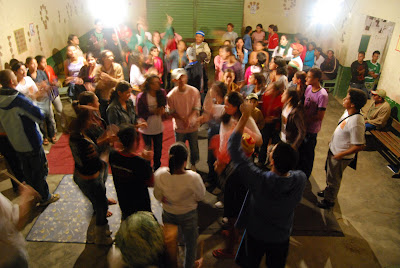
Day 5 ended with a raucous meeting of the youth of Palmópolis, in which Rondonistas and local teenagers worked together to diagnose the ills of the town, as well as prescribe solutions. The atmosphere was electric with hope for real change and a future generation of concerned leaders. The question was, how long would the charge last?
After the meeting, our spirits dampened with some tragic local news that we received from Ana Luísa: a mother of twin infants had committed suicide after discovering that her lover and the father of her children had a mistress. The hardships of daily life being a poor mother in rural Brazil became that much more hard for her to bear. What this meant for our intervention was that the carnival we had planned for the following afternoon for the children of Palmópolis would have to be postponed for the following Saturday. Really, all we could do in the wake of this tragedy to not disturb an already tense and troubled population was spend some much needed R&R.
We slept in a few extra hours Saturday morning before ultimately heading out together to the weekly market near the edge of town, where we perused cheap clothes and plastic knick-knacks from Paraguay, fresh spices, and even fresher cuts of raw meat left exposed to the elements.
That afternoon, we hiked for a few miles outside of Palmópolis along the lone dirt highway toward one of the more beautiful (and less polluted) waterfalls in the area for a picnic lunch. The hour trek was a display of the harshness of rural Brazilian geography: a merciless sun, interminable rolling hills, acidic red-clay soil. And yet the emerald green that such a land could still produce was mesmerizing.
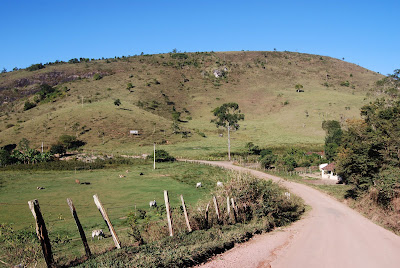
We arrived at the waterfall, cracked open a couple 2-liters of Coke, and devoured ham and cheese sandwiches to refuel from the hike before taking a hoard of pictures and dipping our feet in the icy flowing waters of the cachoeira (waterfall in Portuguese). In a country where eco-tourism is fast becoming a lucrative business, I couldn’t help but think of this cachoeira one day opening up a tiny stream of income for Palmópolis that could then continue to grow. One day. A day when people had reason to come to the area for other than humanitarian motives. When bureaucracy and corruption stepped aside and finally let basic infrastructure be built in Palmópolis. When the town’s youth finally received the education that could give them the mobility to make something of themselves, coupled with a reason and a will to then return and prevent a paralytic brain drain. Such a mound of goals seemed Sisyphean. But if we weren’t there for even our too-short two-week stint, Palmópolis’ boulder would never get its first push up the hill.
 Sunday came and offered us another day of rest, though we used most of it to prepare for a solid second week of intervention, as well as write and present the final chapter of our radio soap opera “Chamas na Bananeira,” “Flames in the Banana Grove,” which we had been broadcasting on the local FM channel for the last few nights. The radionovela told the story of Zé Bananeira, an alcoholic and abusive husband stuck in his traditional machista ways; his neglected elderly mother; his passive yet dignified wife; the couple’s hard-working son looking to get into college; and their young daughter who falls in love with Gringo Zezinho Lima-Lemon (me), who may or may not be the father of her unborn child. With our script—always written at the very last minute—in hand, we’d run to the radio with hopes of giving the people of Palmópolis a half-hour of comic relief, life up their values, and share a pinch of education to spice up the end of their workday.
Sunday also gave us the opportunity to use three of the few computers in town with Internet. Even before checking email I opened up BBC News’ site. In the last week, Iran hadn’t bombed us, we hadn’t bombed Iran, Barack Obama hadn’t been assassinated, John McCain hadn’t died of a heart attack, and overall the world hadn’t come to an end. In Palmópolis, it certainly could have and we wouldn’t have realized it for some time.
Monday morning we loaded into a minibus and endured the bumpy hour-long ride to Dois de Abril. There, job one was administering the survey once again. Do you have water? Electricity? A bathroom? One half-toothless woman with six kids answered this last one thus: “We got a shitter in back, but it ain’t nuthin proper, no.” Not exactly the Portuguese you learn in the classroom. Not exactly the Brazil you see in postcards.

Afterward we divided our remaining day-and-a-half in Dois de Abril into two-hour blocks, broke up into our spontaneous teams, and gave workshops on basic health and hygiene, sex ed, self esteem for women and the elderly, environmental ed. In the latter I got to share with the kids of Dois de Abril one of the greatest works of one of the greatest of American poets: “The Giving Tree” by Shel Silverstein. In a less light-hearted yet equally troubling story, a young girl in the sex ed class told of three friends, aged 15, 16, and 17, who had all gotten pregnant from three brothers all over the age of 30. The three “men” all got the hell out of Dodge when they learned they’d all be dads. In a week that had been free of all political discussion, I raised the issue of whether abortion should be legalized in Brazil to protect uneducated young women such as these three from becoming mothers before their time, or from dangerous illegal abortion operations, which one of the girls informed she had already had. I equated their case as something closer to rape than consensual relations. From even some of my more liberal female team-members, I was met with resistance.
We closed our two days in Dois de Abril with a small play on the importance of preserving the environment, a few last games and songs with the kids, and a bevy of photos of Rondonistas with said kids. It was a rehearsal for a greater and more difficult goodbye to come.
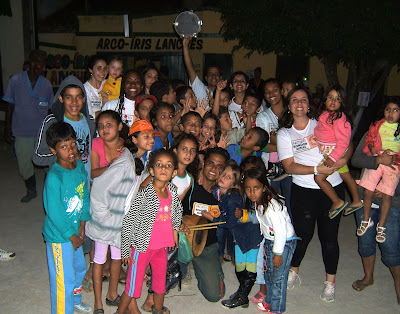
We left for Jeribá at 7:00 the next morning by public bus. Halfway between the two towns, the 30-year-old diesel-belching bus stopped in the serene morning mist to let half-a-dozen men get off and commemorate another day of work under a tympanic sun, surrounded by green shrubs and red earth. We continued on. We reached Jeribá. We climbed up and down its hill several times. We put on our play again, said our goodbyes all too soon, packed up and returned to Palmópolis in an even older bus. We ate. We showered. We slept.
We never had the chance to put on our play in Palmópolis. The Rondon mother ship called us from Belo Horizonte late on our last Friday to inform us that the bus that we thought would be taking us back home early Sunday morning would in fact be there and set to leave before midnight Saturday. More than any previous day, we realized that every last second and every last drop of our energy and will would have to be squeezed out of us on our last, packed day. Our postponed carnival went off with the mirth that was absent from a Saturday prior. Then, after a lightning-fast turnaround, we returned to the main plaza for what was originally planned to be a relaxed closing ceremony for our intervention. With us having to be on board our bus
 by 11pm, an evening in which Palmópolis elderly, its church youth groups, and its Afro-Dance and Capoeira classes all had an opportunity to show us their stuff, all while we said our goodbyes to the dozens of Palmopolenses great and small that had touched our hearts, turned into a frenetic and slightly awkward event. Our last hours as Rondonistas were thus rushed beyond the threshold of Brazilian comfort. But, as the classic cliché would have it, all good things must come to an end, and perhaps this end had to be rushed for the two Brazils of Rondon to take their places back in reality, albeit a reality now imbued with the memories of each other, and the realization of their shared destiny.
And as for me…
 ...I left Palmópolis knowing that I had just completed the greatest challenge of my life. There are few feelings greater than sitting in a bus or train or plane traveling back home (wherever home may be at any given time), looking out the window and thinking simply, "I did it." Your flesh and bones are weary, but your spirit is stronger than ever before. You've got a rucksack full of laundry to do, hundreds of pictures to edit and catalog, and ten times more memories that are already at work reordering the fabric of your mind. Where you go next after some much needed time at home is for tomorrow to tell, as are what parts of here and now you will bring to there and then. You know there's a story to tell. The words still need time to incubate. More than anything, when you look out that window and see that slight reflection of your face flying by mile after mile, you realize how in transition your life really is. Whether or not you believe that the experiences you accumulate one after another are progressively linked by divinely defined destiny, a purpose greater than yourself that the vessel of your body is driven to fulfill, quite honestly doesn't really matter; this is a question that belongs to the sanctity of the faith that each and every one of us has. What we can all agree on is that with each passing challenge, from our first day at school to our first day in a forgotten Brazilian world, we do grow, we do become better human beings, we do see the world that much more clearly. Like the view from the top of a big hill. Maybe not too unlike the hill in Jeribá.

Para todos os meus colegas rondonistas de Palmópolis de julho, 2008.
Amo vocês com todo meu coração.
Obrigado pelas memórias que nunca vou esquecer.

Just before the 5:30pm Brazilian winter sunset, our band of 16 “Rondonistas” left an afternoon of sex ed classes for adolescents and general health classes for Jeribá’s elderly at the school at the summit and headed downhill toward our modest lodging for the day near the intersection of Jeribá’s ‘T’. The deep azure sky specked with orange and purple clouds hovering over an ever-darkening terrain made us pull out our cameras and capture what would be our last sunset in Jeribá.

What a spectacular view this town is blessed with.
That was my first thought. A strange thought at that for a town that has next to nothing, that sustains itself (barely) through small-time agriculture and exporting workers to the industries of São Paulo or Belo Horizonte. Jeribá isn’t even a town; it, along with its sister Dois de Abril, is a mere district of Palmópolis, a metropolis in microcosm. All political and virtually all of the scant economic power is concentrated in this latter town of 7 or 8 thousand, 10 times larger than satellite Jeribá and 4 times that of Dois de Abril.
As the countryside grew darker, so too did the luster of the view from Jeribá’s hill. My mind drifted to earlier that morning. There, after several hours of fun and games with Jeribá’s kids at the school, 9-year-old Débora, her hair shorn like a boy's to a mere couple of inches because of a bout of head lice, remarked how hungry she was. A fellow Rondonista told her not to worry, she’d be heading home soon for lunch. Débora sadly replied, “But there’s no food at home.” The image of this poor girl walking up Jeribá’s enormous hill on an empty stomach, only to find a school with only so much potential to enrich her mind and classmates only too eager to make fun of her haircut that would be beautiful anywhere else in the world but traditional rural Brazil, made the view from the top of the hill at once turn ugly. What if Jeribaenses never even bothered to spend a few seconds of their day to take in the vista? Who’s to say they didn’t deliberately ignore it, seeing it as a curse, beauty forever mocking their plight? Who were we to suddenly gain the right to appropriate this view in little digital boxes?
How did we get so lucky to be the ones wearing the T-shirts with "Projeto Rondon" written on them, taking views like Jeribá's as a sort of "payment" for our volunteerism?
 The Projeto Rondon is named after Brazilian Army Marshall Cândido Rondon, whose life and mission spanned the 19th and 20th centuries. Rondon, of indigenous descent, is renowned for his many explorations of the Brazilian hinterland—including a famous expedition to the Amazon with U.S. President Teddy Roosevelt in 1914—to get to know Brazil’s numerous indigenous tribes and help to integrate them into modern Brazilian society. One of his mottos, used today by the Projeto, was “Integrar para não entregar,” “Integrate, don’t give up.” Give up a people, give up a land, give up the dream of a country united in its forward march marked by order and progress.
The first time university
 students were sent in Rondon's footsteps to better understand their diverse, continent-sized country was in July of 1967, when 30 such students from Rio were flown by military aircraft to (appropriately) Rondônia, the western Brazilian state named after Rondon whose inhabitants live isolated behind the curtain of the Amazon Rainforest. Further joint university-military missions (keep in mind this was at the height of military rule in Brazil, which lasted from 1964-1985) continued sporadically until the mid-70s, when the Projeto was lost to the ever-changing and always tense political atmosphere of the military state. Further missions of integration would have to be made under other auspices until the Projeto Rondon was officially revived in 2003, the first students intervening in January of 2005 in the town of Tabatinga, located on the border with Colombia in far western Amazonas state.
The present-day Projeto continues Rondon's goal of integrating the far-flung peoples of Brazil. The Projeto's flagship programs are found at the national level, where students from the developed southern and southeastern regions of the country connect with their compatriots in the less developed northeast and north. Teams are made up of students from a range of "majors" (to use American terminology), and through a variety of workshops these teams share their collective knowledge and experience with health, literacy, business, valuing and preserving culture, leadership skills, and much more with targeted communities.
But these communities aren't limited to those hidden in the rainforest a thousand miles away from the sands of Ipanema or the hustle and bustle of the Avenida Paulista. Even within the most well-developed states in Brazil's southern half, dozens of poor, rural municipalities exist far outside the orbit of an industrialized metropolis. Thus the need for the Projeto at the state level.
The first interventions in Minas Gerais embarked in July of 2005 for communities with Human Development Indexes under 0.7. Interventions followed in December of 2005, and July and December of 2006, and this year-and-a-half span saw over 1,800 PUC students, educators and staff members bring the project to 53 Mineiro communities, touching the lives of between 50,000 and 60,000 people per trip. Ventures have continued semi-annually since.
I first found out about the Projeto Rondon at an informal get-together for PUC's international students all the way back in February, where a woman involved in the Projeto's administration gave a short presentation. It took about a month for my piqued interest to turn into action. Feeling that my time on this Rotary Ambassadorial Scholarship was lacking a service side to its ambassadorialship, I decided to attend a more detailed informational meeting. Alongside about 500 fellow PUC students, I became sold on the Projeto's mission of bringing integration and solidarity to rural Minas, and the opportunity it offered me to get to see a side of Brazil that I would otherwise never have seen.
After sacrificing 6 of our Saturday afternoons throughout the Brazilian fall semester to prepare for our two weeks as Rondonistas through a series drudging workshops, teams of around 15 students and a coordinator were assembled literally on the eve of departure. For our team of 16, the first few hours on a winding 14-hour bus ride had to suffice for introductions and first impressions before everyone leaned
 their seats back and tried to catch a few uncomfortable winks. Our team comprised of PUC students from health sciences to social sciences, biology and psychology, engineering and law. The youngest was an 18-year-old freshman, the oldest our coordinator Ana Luísa, a recent PUC grad in psychology and a mere 25. Our destination: Palmópolis, a rural community in the northeast corner of Minas Gerais that was officially established as a municipality in 1992, finally giving its inhabitants, mainly temporarily contracted workers in cattle fields and banana groves, a place on the map. Palmópolis, along with other targeted communities, was chosen for its low HDI score: 0.615. What does that mean? Palmópolis is closer to “less developed” than “highly developed” for a variety of reasons: poor education, lack of basic infrastructure, low GDP per capita, limited access to healthcare, among others.
 Ana Luísa had been a Rondonista in Palmópolis before, and after graduating college she lived and worked there for nearly a year. Her experience in Palmópolis, particularly her contacts with those in positions of power, proved invaluable. In a country where mobility is based far more on who you know than what you know, her tireless efforts to talk with just the person who could facilitate our every action made the difference, in my mind, between a successful mission and a potential failure.
 Weary from lack of sleep and bruised from every bump of the final three hours of the ride on a dirt road, we nonetheless donned brightly colored costumes and, like a band of traveling minstrels, paraded through the streets of Palmópolis singing, banging drums, and making our presence known. After about an hour, children began to follow us a la the Pied Piper toward the main plaza, at which point songs and games ensued. After a few hours of singing and playing, more tired than at any point so far that day, we headed back to our headquarters, a social services shelter with Spartan facilities, and wrapped up the day with a series of meetings to prepare for the days ahead, as well as “get-to-know-each-other” games that made up for what was lacking in several waking hours on a bus. We ate our first of two weeks’ worth of delicious, home-cooked, natural and organic meals that we’d wolf down ravenously, and then fell asleep together on the same hard, cold, tiled floor almost the very second we laid prostrate on our inch-thick mats.
Days two and three involved walking up and down the sinuous, spaghetti-bowl streets of Palmópolis,
 knocking on doors and taking surveys of the town’s inhabitants regarding their access to basic utilities and their monthly income. Only a handful, we found, had no electricity. Slightly a few more had no running water, and hardly anyone enjoyed a sanitary sewage system. As for monthly income, the highest recorded was around 3000 reais (~$1800), belonging to a local government minister (the mayor was unavailable for interview—surely his would have broken this mark). The lowest was around 60 reais (~$38), from a widow who cooked the rice and beans bought with this pension check with water from the river, the same river that acted as the local sewer and laundromat.
More than once, the divide between “developed” interviewers and “developing” interviewees became cause for the latter to lash out at us with an indignant “what are you doing here?”, or “we have nothing here, and how are you going to help us out?”. Near the end of each day, our band would meet for an hour to decompress from dozens of interviews, share our perspectives of the town, and tie tighter the bonds we had been continuing to weave together. The evening would be capped off—as would be the case for the remainder of our days as Rondonistas—with a three-hour-long rotation to take a much-coveted shower.
 On day 4, a Thursday, our interaction with the people of Palmópolis began in earnest. The morning began with a series of games at the local school: soccer, hopscotch, peteca (an indigenous game played like badminton, only you use your hands, see photo at left), and, an American classic, tossing around a Frisbee. In one of the last games, played mainly with smaller children, the de facto motto of our intervention was born: “Todo mundo ganhou!” “Everybody wins!”

Our hope with the morning of games was to rile the kids of Palmópolis up enough so that they’d be somewhat calm for more serious activities in the afternoon: talks about familial relations and storytelling and literacy activities. Not to be. The same kids from the morning were twice as rambunctious, chasing each other and climbing trees and distracting those few who wanted to participate. From American eyes, it suddenly became easy to see where lay the roots of a society that has minimal respect for law and where discipline is toothless. Meanwhile, a second contingent of our team was working with Palmópolis’ elderly on how to properly exercise in their twilight years. In our meeting later that evening the discussions generated by both halves of the team revealed yet another divide taking place all over Brazilian society—really, all over the world: the age divide. Kids solely seeking new and better means for stimulation have no patience for the repositories of wisdom, traditions and values, stories of a hard yet glory-filled past. What would the wild and crazy kids from today’s activities have to tell their grandkids 60 years from now? How they ran around and hit each other, then went home and watched cartoons?
 The morning of day 5 introduced us to a group of kids in whom seeds of tradition were being carefully planted. Our planned activity for the morning was to show a film for the kids of Palmópolis, with the objectives being to 1) pull kids off the streets, and 2) give less fortunate children the opportunity to see a movie they may never have the chance to see. The movie: The Incredibles. The locale: Palmópolis’ Casa da Cultura, the House of Culture. There, along with a handful of kids we had coaxed from kicking dirt in the street, we bore witness to one of the bright spots of the town: the children’s Afro-Dance and Capoeira (a Brazilian martial art) class. We let the class continue for an hour or so, about half its normal time, and even participated in some of the dance steps and percussion. At the end of the class, after the 20 or so kids had gracefully flowed through dance after dance, the three teachers had the chorus of students shout out the class rules:
1. Respect your teachers
2. Respect your classmates
3. Don’t fight
4. Don’t skip class
5. Respect all the mestres (Capoeira masters) that came before you
I wonder if one of these kids will grow up to write the book "Everything I Every Need to Know, I Learned in Afro-Dance Class."
The class went to wash up, and then came back and sat down to watch the movie. The transition seemed all too strange. Don’t get me wrong, The Incredibles is a fantastic movie, and I do believe showing it had the potential to expand the budding imaginations of all the kids in that room. But to cut into a class that taught these kids the values of their own cultural heritage, only to show them a film that had nothing to do with their lives, that didn’t teach them order and respect, it seemed terribly out of place. Marx would call it alienation of one culture by another. I’m no Marxist, but I’d have to agree with him on this one.
Day 5 ended with a raucous meeting of the youth of Palmópolis, in which Rondonistas and local teenagers worked together to diagnose the ills of the town, as well as prescribe solutions. The atmosphere was electric with hope for real change and a future generation of concerned leaders. The question was, how long would the charge last?

After the meeting, our spirits dampened with some tragic local news that we received from Ana Luísa: a mother of twin infants had committed suicide after discovering that her lover and the father of her children had a mistress. The hardships of daily life being a poor mother in rural Brazil became that much more hard for her to bear. What this meant for our intervention was that the carnival we had planned for the following afternoon for the children of Palmópolis would have to be postponed for the following Saturday. Really, all we could do in the wake of this tragedy to not disturb an already tense and troubled population was spend some much needed R&R.
We slept in a few extra hours Saturday morning before ultimately heading out together to the weekly market near the edge of town, where we perused cheap clothes and plastic knick-knacks from Paraguay, fresh spices, and even fresher cuts of raw meat left exposed to the elements.
That afternoon, we hiked for a few miles outside of Palmópolis along the lone dirt highway toward one of the more beautiful (and less polluted) waterfalls in the area for a picnic lunch. The hour trek was a display of the harshness of rural Brazilian geography: a merciless sun, interminable rolling hills, acidic red-clay soil. And yet the emerald green that such a land could still produce was mesmerizing.

We arrived at the waterfall, cracked open a couple 2-liters of Coke, and devoured ham and
 cheese sandwiches to refuel from the hike before taking a hoard of pictures and dipping our feet in the icy flowing waters of the cachoeira (waterfall in Portuguese). In a country where eco-tourism is fast becoming a lucrative business, I couldn’t help but think of this cachoeira one day opening up a tiny stream of income for Palmópolis that could then continue to grow. One day. A day when people had reason to come to the area for other than humanitarian motives. When bureaucracy and corruption stepped aside and finally let basic infrastructure be built in Palmópolis. When the town’s youth finally received the education that could give them the mobility to make something of themselves, coupled with a reason and a will to then return and prevent a paralytic brain drain. Such a mound of goals seemed Sisyphean. But if we weren’t there for even our too-short two-week stint, Palmópolis’ boulder would never get its first push up the hill.
 Sunday came and offered us another day of rest, though we used most of it to prepare for a solid second week of intervention, as well as write and present the final chapter of our radio soap opera “Chamas na Bananeira,” “Flames in the Banana Grove,” which we had been broadcasting on the local FM channel for the last few nights. The radionovela told the story of Zé Bananeira, an alcoholic and abusive husband stuck in his traditional machista ways; his neglected elderly mother; his passive yet dignified wife; the couple’s hard-working son looking to get into college; and their young daughter who falls in love with Gringo Zezinho Lima-Lemon (me), who may or may not be the father of her unborn child. With our script—always written at the very last minute—in hand, we’d run to the radio with hopes of giving the people of Palmópolis a half-hour of comic relief, life up their values, and share a pinch of education to spice up the end of their workday.
Sunday also gave us the opportunity to use three of the few computers in town with Internet. Even before checking email I opened up BBC News’ site. In the last week, Iran hadn’t bombed us, we hadn’t bombed Iran, Barack Obama hadn’t been assassinated, John McCain hadn’t died of a heart attack, and overall the world hadn’t come to an end. In Palmópolis, it certainly could have and we wouldn’t have realized it for some time.
Monday morning we loaded into a minibus and endured the bumpy hour-long ride to Dois de Abril. There, job one was administering the survey once again. Do you have water? Electricity? A bathroom? One half-toothless woman with six kids answered this last one thus: “We got a shitter in back, but it ain’t nuthin proper, no.” Not exactly the Portuguese you learn in the classroom. Not exactly the Brazil you see in postcards.

Afterward we divided our remaining day-and-a-half in Dois de Abril into two-hour blocks, broke up into our spontaneous teams, and gave workshops on basic health and hygiene, sex ed, self esteem for women and the elderly, environmental ed. In the latter I got to share with the kids of Dois de Abril one of the greatest works of one of the greatest of American poets: “The Giving Tree” by Shel Silverstein. In a less light-hearted yet equally troubling story, a young girl in the sex ed class told of three friends, aged 15, 16, and 17, who had all gotten pregnant from three brothers all over the age of 30. The three “men” all got the hell out of Dodge when they learned they’d all be dads. In a week that had been free of all political discussion, I raised the issue of whether abortion should be legalized in Brazil to protect uneducated young women such as these three from becoming mothers before their time, or from dangerous illegal abortion operations, which one of the girls informed she had already had. I equated their case as something closer to rape than consensual relations. From even some of my more liberal female team-members, I was met with resistance.
We closed our two days in Dois de Abril with a small play on the importance of preserving the environment, a few last games and songs with the kids, and a bevy of photos of Rondonistas with said kids. It was a rehearsal for a greater and more difficult goodbye to come.

We left for Jeribá at 7:00 the next morning by public bus. Halfway between the two towns, the 30-year-old diesel-belching bus stopped in the serene morning mist to let half-a-dozen men get off and commemorate another day of work under a tympanic sun, surrounded by green shrubs and red earth. We continued on. We reached Jeribá. We climbed up and down its hill several times. We put on our play again, said our goodbyes all too soon, packed up and returned to Palmópolis in an even older bus. We ate. We showered. We slept.
We never had the chance to put on our play in Palmópolis. The Rondon mother ship called us
 from Belo Horizonte late on our last Friday to inform us that the bus that we thought would be taking us back home early Sunday morning would in fact be there and set to leave before midnight Saturday. More than any previous day, we realized that every last second and every last drop of our energy and will would have to be squeezed out of us on our last, packed day. Our postponed carnival went off with the mirth that was absent from a Saturday prior. Then, after a lightning-fast turnaround, we returned to the main plaza for what was originally planned to be a relaxed closing ceremony for our intervention. With us having to be on board our bus
 by 11pm, an evening in which Palmópolis elderly, its church youth groups, and its Afro-Dance and Capoeira classes all had an opportunity to show us their stuff, all while we said our goodbyes to the dozens of Palmopolenses great and small that had touched our hearts, turned into a frenetic and slightly awkward event. Our last hours as Rondonistas were thus rushed beyond the threshold of Brazilian comfort. But, as the classic cliché would have it, all good things must come to an end, and perhaps this end had to be rushed for the two Brazils of Rondon to take their places back in reality, albeit a reality now imbued with the memories of each other, and the realization of their shared destiny.
And as for me…
 ...I left Palmópolis knowing that I had just completed the greatest challenge of my life. There are few feelings greater than sitting in a bus or train or plane traveling back home (wherever home may be at any given time), looking out the window and thinking simply, "I did it." Your flesh and bones are weary, but your spirit is stronger than ever before. You've got a rucksack full of laundry to do, hundreds of pictures to edit and catalog, and ten times more memories that are already at work reordering the fabric of your mind. Where you go next after some much needed time at home is for tomorrow to tell, as are what parts of here and now you will bring to there and then. You know there's a story to tell. The words still need time to incubate. More than anything, when you look out that window and see that slight reflection of your face flying by mile after mile, you realize how in transition your life really is. Whether or not you believe that the experiences you accumulate one after another are progressively linked by divinely defined destiny, a purpose greater than yourself that the vessel of your body is driven to fulfill, quite honestly doesn't really matter; this is a question that belongs to the sanctity of the faith that each and every one of us has. What we can all agree on is that with each passing challenge, from our first day at school to our first day in a forgotten Brazilian world, we do grow, we do become better human beings, we do see the world that much more clearly. Like the view from the top of a big hill. Maybe not too unlike the hill in Jeribá.

Para todos os meus colegas rondonistas de Palmópolis de julho, 2008.
Amo vocês com todo meu coração.
Obrigado pelas memórias que nunca vou esquecer.
Saturday, August 23, 2008
All (Brazilian) Politics Is Local
In typical Brazilian fashion, the debate started at 7:30pm instead of 7:00, though we were happy to have gotten to PUC’s auditorium by 6:55 and been spared from having to squat in the aisles or crowding in the back near the exits.
Is it really any wonder there’s no adherence to fire codes in Brazil?
 Ricardo and I found seats near the front right of the auditorium. For a half-hour we watched photographers and TV cameramen get in position to immortalize the Belo Horizonte mayoral debate that was about to take place. As the seats filled up, foot soldiers (“militantes”) pushed pamphlets and platforms of their respective candidate from the 8 parties represented in the debate. By 7:29 we had collected a dozen new brightly colored leaflets to add to our collection in the drawer below our TV that had been growing steadily in the last few weeks as the campaigns for the October 5th vote started to pick up speed.
And then, in the name of progress, order was called for by PUC’s student body president. He and a gray-haired local journalist—who a generation ago was likely taking part in a different kind of manifestation of political culture in a different kind of political climate—laid down the rules they would follow to moderate the debate. Each of the 8 candidates would have 2 minutes to introduce him or herself and his or her campaign. Next, 2 journalists from local newspapers would ask a question for 4 of the candidates to answer in 2 minutes each. In part three, volunteers would draw the names of 2 students from a box placed in front of each candidate, and these lucky 16 would ask a question of their chosen candidate, who would, again, have 2 minutes to answer each question. The debate would then wrap up with a (wait for it…) 2-minute closing statement from each candidate.
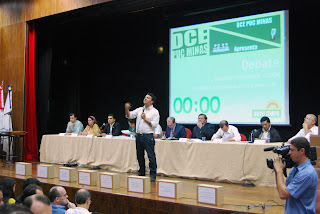
While it was at first a shock, after 6+ months living with virtually no reverence for time, to see the giant timer projected behind the stage counting down each 2-minute segment, I was glad to see it. If it weren’t there, the longwinded-squared nature of these 8 being both Brazilian and politicians would have taken the debate into the next morning.
The 8 candidates represented the following parties:
PDT: Partido Democrático Trabalhista, Democratic Labor Party
PCO: Partido da Causa Operária, Workers’ Cause Party
PMDB: Partido do Movimento Democrático Brasileiro, Brazilian Democratic Movement Party
PRTB: Partido Renovador Trabalhista Brasileiro, Brazilian Labor Renewal Party
PSB: Partido Socialista Brasileiro, Brazilian Socialist Party
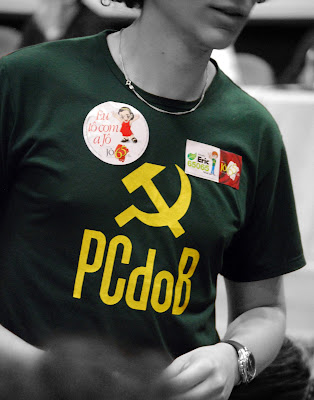
PCdoB: Partido Comunista do Brasil, Communist Party of Brazil
PSTU: Partido Socialista dos Trabalhadores Unificado, Unified Socialist Workers’ Party
DEM: Democratas, Democrats
According to the greatest of all references, Wikipedia (see article), there are 27 "official" political parties in Brazil. Of these 27, Wikipedia classifies 6 as “major”: PDT, PMDB, DEM, along with PT (Partido dos Trabalhadores, Labor Party), PSDB (Partido Social Democrático Brasileiro, Brazilian Social Democratic Party), and PP (Partido Progressivo, Progressive Party). (PT, PMDB, and PSDB are the juggernaut parties nationally, with PP, DEM, and PDT a tier behind and more influential at the state level). Left to right on the political spectrum, these 6 go like this:
Of Wikipedia’s 6 “medium level” parties (which I won’t bother listing), the PCdoB and PSB supported candidates for the debate, while the PCO, PRTB, PCB, and PSTU represented the 15 “minor parties” in Brazilian politics at the debate.
I should note how municipal campaigns work down here.
First, there are the mayoral candidates themselves, affiliated with a particular party.
Piece of cake.
Beneath them are candidates for a given number of seats as vereadores, something along the lines of city councilors, who, if elected, will be in charge of drafting policies for a particular area of government (i.e. health, education, transportation, etc.). Each candidate for vereador affiliates him or herself with a particular party. All vereador candidates in one party share party resources for publicity (TV ads, cartels, leaflets, bumper-stickers, etc.), yet all compete against each other as well as against candidates from other parties.
Some parties, usually small ones having no candidate for mayor themselves, will form alliances among themselves and with larger parties supporting a candidate. In such a symbiotic alliance, the larger party’s mayoral candidate will ideally gain the votes of the rank-and-file of smaller parties, and the candidates for vereador from small parties will have a more “name brand” candidate to latch onto in their quest for a piece of power.

I should probably take a step back and answer the obvious question: why all the parties?
At the municipal level, and when voting for Brazil’s equivalent of congressmen and women at the national stage, Brazil’s electoral system is proportional. Extremely so. In 2006, for instance, winning 0.3% of the vote got some parties at least 1 seat in Brazil’s equivalent of the House of Representatives. Thus, there’s plenty of incentive for small parties to get out there and try their hand at government. At the gubernatorial and presidential levels, a candidate wins by an absolute majority, giving the country’s major parties an edge (like in France, a run-off is held between the top two first-round finishers if there is no absolute victor). Current President Luis Inácio Lula da Silva (“Lula” for short) is from PT.
What are the consequences of Brazil’s hyper-proportional system that makes even Israeli politics look exclusivist?
 First, obviously, there’s division, most especially on the left. Historically, this is nothing new; divergence in the leftist camp starts at the roots, with discrepancies among Lenin, Trotsky, Tito, Stalin, and Mao and their interpretations of Marxist thought, not to mention the differences between all those who have tried to follow in these giants' footsteps. Alliances must thus be made to avert the complete fracturing of the Brazilian left, though these alliances aren’t guaranteed to last from one election to another and will change with the variable winds of politics. Alliances also must be formed in Congress to assure that bills get passed by simple majority. In such a climate of mutual back-scratching, gridlock and spectral antagonism tend to be less prevalent than strictly two-party systems such as our own. A definite plus in my book. On the negative side, an interesting analysis would be to see whether within these multiple points of political bargaining exists the roots of Brazil's rampant culture of political corruption.
Another plus for Brazil's proportional system: direct participation in politics becomes more active, with more people fighting for the votes of an ever more pluralist electorate. One could maybe argue that a proportional electoral system leads to an increase in voter participation, as there exists a greater probability that a given party’s platform will match a voter’s beliefs, giving her greater incentive to vote. In Brazil, however, that argument is a moot point, as voting is compulsory.
In sum, Brazil’s electoral system is a far cry from our own, where two giant heavyweights duke it out at every level of politics for a majority of votes. Personally, while I wouldn’t favor a system in which I’d have to argue why the American Democratic Party is better than the Democratic Party of America, a little variety in our Redemopublicratican reality would be refreshing. Right Greens? Libertarians?
All right, back to the debate. Each candidate carefully carved out 2 minutes worth of thanking student government, introducing him or herself, and towing the party line through well-tuned sound bites, which received a din of cheers, boos, and the occasional chant or two. Then came the journalists’ questions, one having to do with BH’s health services, the other about which aspects of the present city administration should change and which should remain the same. As good politicians do, each spun the questions to his or her liking.
Then the fun started.
It’s no secret that young people the world over, especially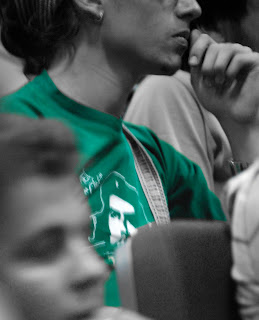 college students, tend toward the gauche of the political spectrum. This is perhaps more true in Brazil than anywhere else on the planet. Che Guevara, maybe the only Argentine a Brazilian ever liked, is more than a pop culture icon in Brazil; he’s a god. Dependence Theory—the Marxist school of thought that blames Brazil’s economic backwardness on an omnipresent, unscrupulous, capitalist, imperialist metropolis, be it Portugal, Britain, or the U.S.A.—has been the mode in Brazilian economic thought since then economist and future President Fernando Henrique Cardoso first penned it in the 1960s. College professors, who a generation ago were revolutionary youth mixed up in the chaff of military repression, have resurged to breathe new life into their leftist ideals in classrooms nationwide.
But perhaps the one element that catalyzes the formation of Brazilian youth’s political ideology (and this is a half-baked hypothesis, mind you) is Brazil’s bacchanal bar culture. At even (perhaps especially) the most hole-in-the-wall bars, hedonism flows by the liter, spreads with each random kiss, and gives Brazilians of all ages—but especially college students—a no-stress identity that they would never trade in even to become the world’s wealthiest nation. Brazil’s botecos have become the coffeehouses of Voltaire’s France, where revolutionary fraternité grows with every reason to drink to the end of the self-righteous, stuffy, and moralistic hegemony of the United States.

 So, one by one, names were drawn and students rose and addressed each candidate in front of their peers in a room full of revolutionary iconographic T-shirts and dreadlocks. The questions were politically savvy, having to do with how candidates would work for social integration, more organized public transportation, free or reduced bus fares for students, greater environmental stewardship, and better healthcare for BH, among other things. Order was broken once when an elderly woman in the back of the audience cried out for the interests of her demographic not to be forgotten. The moderators gave her the floor for the standard 2 minutes, allowed a couple of the candidates a short response, and then continued through the scheduled format. With each
 question, candidates did their best to give a general yet satisfying analysis of the issues, sketch out a few specific solutions, and throw out phrases to rile the demographically and ideologically biased audience into a frenzy: “Free bus fares for all students!” “More investment in public education!” The firebrand candidate for the PCO went off on a tirade against the oppression of the Catholic Church in keeping abortion illegal in Brazil, and somehow managed to connect that with a jab at American imperialism, which would have probably won a greater reaction from this crowd had it been better timed and the candidate running for a position higher than mayor of Brazil’s 3rd largest city.
By 10 o’clock, Ricardo and I both decided we’d had enough and decided to leave before the closing statements. We weren’t alone; the tired crowd had already begun to dwindle, and we followed others out the door like fans at a lopsided basketball game. On the way out, we a caught a glimpse of an anarchist’s half-hearted handiwork: a graphically designed sign that read “Question all authority” beneath a grouping of blank white faces in suits, and a handmade one that said simply “Não vote, fume!” “Don’t vote, smoke!”
As we approached the campus exit, we saw we’d have to run the gauntlet through a half-dozen or so foot soldiers aiming to get rid of their 2-inch thick stacks of leaflets. One girl gave Ricardo not one but three such political trading cards of a particular candidate for vereador. The ever quick-witted Ricardo shot back, “Are you promoting the guy, or the cards?” Perhaps his quip was unjust; she may truly have sympathized with the candidate and his policies. But when you see people daily in front of PUC handing out leaflets for this restaurant, that English school, or another transport service, and when smalltime politicians like vereadores project themselves as products to be bought, with unique names like Antônio Cowboy and Amigão and catchy TV jingles to win votes, you have to wonder if he indeed had a point.
Is it really any wonder there’s no adherence to fire codes in Brazil?
 Ricardo and I found seats near the front right of the auditorium. For a half-hour we watched photographers and TV cameramen get in position to immortalize the Belo Horizonte mayoral debate that was about to take place. As the seats filled up, foot soldiers (“militantes”) pushed pamphlets and platforms of their respective candidate from the 8 parties represented in the debate. By 7:29 we had collected a dozen new brightly colored leaflets to add to our collection in the drawer below our TV that had been growing steadily in the last few weeks as the campaigns for the October 5th vote started to pick up speed.
And then, in the name of progress, order was called for by PUC’s student body president. He and a gray-haired local journalist—who a generation ago was likely taking part in a different kind of manifestation of political culture in a different kind of political climate—laid down the rules they would follow to moderate the debate. Each of the 8 candidates would have 2 minutes to introduce him or herself and his or her campaign. Next, 2 journalists from local newspapers would ask a question for 4 of the candidates to answer in 2 minutes each. In part three, volunteers would draw the names of 2 students from a box placed in front of each candidate, and these lucky 16 would ask a question of their chosen candidate, who would, again, have 2 minutes to answer each question. The debate would then wrap up with a (wait for it…) 2-minute closing statement from each candidate.

While it was at first a shock, after 6+ months living with virtually no reverence for time, to see the giant timer projected behind the stage counting down each 2-minute segment, I was glad to see it. If it weren’t there, the longwinded-squared nature of these 8 being both Brazilian and politicians would have taken the debate into the next morning.
The 8 candidates represented the following parties:
PDT: Partido Democrático Trabalhista, Democratic Labor Party
PCO: Partido da Causa Operária, Workers’ Cause Party
PMDB: Partido do Movimento Democrático Brasileiro, Brazilian Democratic Movement Party
PRTB: Partido Renovador Trabalhista Brasileiro, Brazilian Labor Renewal Party
PSB: Partido Socialista Brasileiro, Brazilian Socialist Party
PCdoB: Partido Comunista do Brasil, Communist Party of Brazil
PSTU: Partido Socialista dos Trabalhadores Unificado, Unified Socialist Workers’ Party
DEM: Democratas, Democrats
According to the greatest of all references, Wikipedia (see article), there are 27 "official" political parties in Brazil. Of these 27, Wikipedia classifies 6 as “major”: PDT, PMDB, DEM, along with PT (Partido dos Trabalhadores, Labor Party), PSDB (Partido Social Democrático Brasileiro, Brazilian Social Democratic Party), and PP (Partido Progressivo, Progressive Party). (PT, PMDB, and PSDB are the juggernaut parties nationally, with PP, DEM, and PDT a tier behind and more influential at the state level). Left to right on the political spectrum, these 6 go like this:
PDT – PT – PMDB – PSDB – DEM – PP
Of Wikipedia’s 6 “medium level” parties (which I won’t bother listing), the PCdoB and PSB supported candidates for the debate, while the PCO, PRTB, PCB, and PSTU represented the 15 “minor parties” in Brazilian politics at the debate.

I should note how municipal campaigns work down here.
First, there are the mayoral candidates themselves, affiliated with a particular party.
Piece of cake.
Beneath them are candidates for a given number of seats as vereadores, something along the lines of city councilors, who, if elected, will be in charge of drafting policies for a particular area of government (i.e. health, education, transportation, etc.). Each candidate for vereador affiliates him or herself with a particular party. All vereador candidates in one party share party resources for publicity (TV ads, cartels, leaflets, bumper-stickers, etc.), yet all compete against each other as well as against candidates from other parties.
Some parties, usually small ones having no candidate for mayor themselves, will form alliances among themselves and with larger parties supporting a candidate. In such a symbiotic alliance, the larger party’s mayoral candidate will ideally gain the votes of the rank-and-file of smaller parties, and the candidates for vereador from small parties will have a more “name brand” candidate to latch onto in their quest for a piece of power.

I should probably take a step back and answer the obvious question: why all the parties?
At the municipal level, and when voting for Brazil’s equivalent of congressmen and women at the national stage, Brazil’s electoral system is proportional. Extremely so. In 2006, for instance, winning 0.3% of the vote got some parties at least 1 seat in Brazil’s equivalent of the House of Representatives. Thus, there’s plenty of incentive for small parties to get out there and try their hand at government. At the gubernatorial and presidential levels, a candidate wins by an absolute majority, giving the country’s major parties an edge (like in France, a run-off is held between the top two first-round finishers if there is no absolute victor). Current President Luis Inácio Lula da Silva (“Lula” for short) is from PT.
What are the consequences of Brazil’s hyper-proportional system that makes even Israeli politics look exclusivist?
 First, obviously, there’s division, most especially on the left. Historically, this is nothing new; divergence in the leftist camp starts at the roots, with discrepancies among Lenin, Trotsky, Tito, Stalin, and Mao and their interpretations of Marxist thought, not to mention the differences between all those who have tried to follow in these giants' footsteps. Alliances must thus be made to avert the complete fracturing of the Brazilian left, though these alliances aren’t guaranteed to last from one election to another and will change with the variable winds of politics. Alliances also must be formed in Congress to assure that bills get passed by simple majority. In such a climate of mutual back-scratching, gridlock and spectral antagonism tend to be less prevalent than strictly two-party systems such as our own. A definite plus in my book. On the negative side, an interesting analysis would be to see whether within these multiple points of political bargaining exists the roots of Brazil's rampant culture of political corruption.
Another plus for Brazil's proportional system: direct participation in politics becomes more active, with more people fighting for the votes of an ever more pluralist electorate. One could maybe argue that a proportional electoral system leads to an increase in voter participation, as there exists a greater probability that a given party’s platform will match a voter’s beliefs, giving her greater incentive to vote. In Brazil, however, that argument is a moot point, as voting is compulsory.
In sum, Brazil’s electoral system is a far cry from our own, where two giant heavyweights duke it out at every level of politics for a majority of votes. Personally, while I wouldn’t favor a system in which I’d have to argue why the American Democratic Party is better than the Democratic Party of America, a little variety in our Redemopublicratican reality would be refreshing. Right Greens? Libertarians?
All right, back to the debate. Each candidate carefully carved out 2 minutes worth of thanking student government, introducing him or herself, and towing the party line through well-tuned sound bites, which received a din of cheers, boos, and the occasional chant or two. Then came the journalists’ questions, one having to do with BH’s health services, the other about which aspects of the present city administration should change and which should remain the same. As good politicians do, each spun the questions to his or her liking.
Then the fun started.
It’s no secret that young people the world over, especially
 college students, tend toward the gauche of the political spectrum. This is perhaps more true in Brazil than anywhere else on the planet. Che Guevara, maybe the only Argentine a Brazilian ever liked, is more than a pop culture icon in Brazil; he’s a god. Dependence Theory—the Marxist school of thought that blames Brazil’s economic backwardness on an omnipresent, unscrupulous, capitalist, imperialist metropolis, be it Portugal, Britain, or the U.S.A.—has been the mode in Brazilian economic thought since then economist and future President Fernando Henrique Cardoso first penned it in the 1960s. College professors, who a generation ago were revolutionary youth mixed up in the chaff of military repression, have resurged to breathe new life into their leftist ideals in classrooms nationwide.
But perhaps the one element that catalyzes the formation of Brazilian youth’s political ideology (and this is a half-baked hypothesis, mind you) is Brazil’s bacchanal bar culture. At even (perhaps especially) the most hole-in-the-wall bars, hedonism flows by the liter, spreads with each random kiss, and gives Brazilians of all ages—but especially college students—a no-stress identity that they would never trade in even to become the world’s wealthiest nation. Brazil’s botecos have become the coffeehouses of Voltaire’s France, where revolutionary fraternité grows with every reason to drink to the end of the self-righteous, stuffy, and moralistic hegemony of the United States.

 So, one by one, names were drawn and students rose and addressed each candidate in front of their peers in a room full of revolutionary iconographic T-shirts and dreadlocks. The questions were politically savvy, having to do with how candidates would work for social integration, more organized public transportation, free or reduced bus fares for students, greater environmental stewardship, and better healthcare for BH, among other things. Order was broken once when an elderly woman in the back of the audience cried out for the interests of her demographic not to be forgotten. The moderators gave her the floor for the standard 2 minutes, allowed a couple of the candidates a short response, and then continued through the scheduled format. With each
 question, candidates did their best to give a general yet satisfying analysis of the issues, sketch out a few specific solutions, and throw out phrases to rile the demographically and ideologically biased audience into a frenzy: “Free bus fares for all students!” “More investment in public education!” The firebrand candidate for the PCO went off on a tirade against the oppression of the Catholic Church in keeping abortion illegal in Brazil, and somehow managed to connect that with a jab at American imperialism, which would have probably won a greater reaction from this crowd had it been better timed and the candidate running for a position higher than mayor of Brazil’s 3rd largest city.
By 10 o’clock, Ricardo and I both decided we’d had enough and decided to leave before the closing statements. We weren’t alone; the tired crowd had already begun to dwindle, and we followed others out the door like fans at a lopsided basketball game. On the way out, we a caught a glimpse of an anarchist’s half-hearted handiwork: a graphically designed sign that read “Question all authority” beneath a grouping of blank white faces in suits, and a handmade one that said simply “Não vote, fume!” “Don’t vote, smoke!”

As we approached the campus exit, we saw we’d have to run the gauntlet through a half-dozen or so foot soldiers aiming to get rid of their 2-inch thick stacks of leaflets. One girl gave Ricardo not one but three such political trading cards of a particular candidate for vereador. The ever quick-witted Ricardo shot back, “Are you promoting the guy, or the cards?” Perhaps his quip was unjust; she may truly have sympathized with the candidate and his policies. But when you see people daily in front of PUC handing out leaflets for this restaurant, that English school, or another transport service, and when smalltime politicians like vereadores project themselves as products to be bought, with unique names like Antônio Cowboy and Amigão and catchy TV jingles to win votes, you have to wonder if he indeed had a point.
Sunday, July 6, 2008
Rio
Imagine if New Yorkers had world-renowned beaches just a few neighborhoods away from downtown Manhattan. They would be that much more chauvinistic of their city that never sleeps. They would be, in effect, Cariocas. While São Paulo is most often compared to the Big Apple (both are each country’s biggest metropolis, both account for a healthy share of each country’s economy), Rio, with its many comparisons to San Francisco (its European feel, its trolley cars, its large gay population), may indeed be best considered the “Big Pineapple” of Brazil. This simply by virtue of its people: chauvinistic to the point of jingoism, and with a jeito malandro (a New York swagger, if you will) all their own that sustains their identity with their hard-knock city.
As for Minas, many of my Mineiro friends have proudly claimed their state to be the Texas of Brazil. It’s one of the biggest states in Brazil, it prides itself on its traditionalism, and the virile image of the tropeiro (responsible for seeing goods in and out of Minas on treacherous 18th and 19th century roads) parallels that of the Texas cowboy. The biggest difference that sticks out between Minas and Texas is that the latter has a coast. The Gulf of Mexico may not be the crystalline blue waters of the open Atlantic, but it gives Texas a coast nonetheless. Landlocked Mineiros claim that that’s the only thing keeping Minas from being the perfect state; it already has mountains, forests, and a heart as big as, well, Minas.
(There’s a saying in Minas that goes: “Já que Minas não tem mar, eu vou pro bar” – “Since Minas has no sea, I’m going to the bar.”)
In the absence of ocean, neighboring Espírito Santo state has become somewhat of a colony of Minas, with the small beach town Guarapari attracting the most Mineiros to its sands. My roommate, Ricardo, is a Capixaba (an indigenous word used to refer to inhabitants of Espírito Santo), and he says it’s easy to spot Mineiros on the shores of his state: they’re the ones ripping off their outer-garments and running and screaming in an ecstatic frenzy into the waters they’ve been so deprived of.
Mineiros with a bit more money will head to the white sand beaches and glass-colored icy lagoons of aptly named Cabo Frio (“Cold Cape”) on the far eastern tip of the state of Rio de Janeiro. There, Antarctic waters cool off a mix of Mineiros, Cariocas, and Capixabas, slow-cooked under Brazil’s ferocious summer sun.
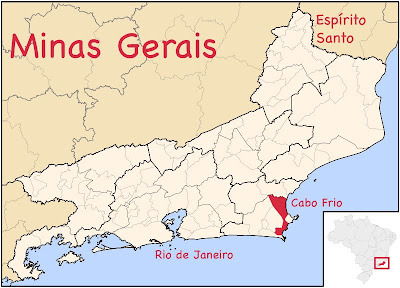
Only the wealthy and brave among Mineiros opt to prop up their beach umbrellas and sip on Skols or Caipirinhas on the beaches of Rio de Janeiro the city.
The names Copacabana and Ipanema are well ingrained in every Brazilian’s mind, and many an American’s as well. Ipanema conjures up images crafted by Tom Jobim in the immortal Bossa Nova standard “The Girl from Ipanema,” while Copacabana gets catalogued in our minds under the same tropical paradise category as Cancún. Perhaps that’s why you’re likely to find more Gringos than Mineiros among all the Cariocas on these and other (Leblon, Barra, Praia Vermelha) world famous beaches of Rio.
Really, when we Americans think of Brazil, we think Rio. The name Rio stirs up visions of Latin sensuality, of beaches full of beautiful women in skimpy bikinis, and muscular surfer/soccer-player guys with equally revealing
 sungas (what Brazilians call Speedos). We more than half-expect samba music to be playing naturally in the air, and sex on the beach to be more than just a drink in Rio. What we don’t expect, and why it takes a brave Mineiro to get their beach-fix in Rio, is the “Jeito Carioca,” a Carioca’s will to make ripping off tourists their livelihood.
Recently the weekly TV show CQC, the Brazilian equivalent of “The Daily Show”, aired a special report about the honesty of cab drivers in Rio. One reporter took a taxi from one point of the city to another, chatted with the cabby, spoke in a Carioca accent, and overall made it obvious that he was a local. His fare came to around 12 reais. Another reporter got in another cab, took the same route, spoke in broken Portuguese to fake being a foreigner, and ended up with a fare of 60 reais. When a third reporter came up to the second cab driver and asked him if he thought Brazilians were “an honest people,” the driver emphatically said yes. When the reporter then confronted him with the stunt they had just pulled on him, the cabby sped off without so much as a word.
In my recent trip to Rio with a couple of friends, we were lucky to not run into anything near the second cab driver. The worst we encountered was a cabby who pilfered us for 2 more reais on our fare by pointing to his confusing “Fare Chart” that all of Rio’s taxi drivers keep on their dashboards, which they’ll expect naïve tourists to take it as Gospel when they use it as “proof” that their fare is more than what the meter says. In a not-so-ambassadorial moment, I gave that particular driver his 2 reais, told him where he could stick his chart, and slammed the door, hopefully giving him the hint that his tricks won’t work on every tourist, though it's not very likely. His antics likely came because the trip was a short one, and I didn’t get the chance to make small talk with him. With every other cab the three of us got into, I made it a point to talk with the driver, catching him (or the occasional her) off guard with my nearly perfect Portuguese. By the end of the route, there was no way he/she could rip me off after such a pleasant conversation, or witnessing the miracle of an American that actually spoke his/her language.
Aside from the Jeito Carioca, Mineiros have a better sense than the average naïve American tourist about the dangers that lurk in Rio’s shadows. Such films as City of God, Bus 174, and the recent smash hit Tropa de Elite (which, if it ever comes out in the U.S.—doubtful because Brazilians were outraged that it got snubbed at the Oscars after winning several top awards at other international film festivals—will be called Elite Squad) are all a Mineiro needs to see to know that Rio isn’t Minas, just like New York isn’t Texas. The first and third films are based on true stories, while the second uses media footage of an actual bus hijacking in 2000. Yes, unfortunately, there’s no denying that Rio is notorious for its high crime rate. I’m happy to say, though, that by acknowledging this sad truth I have ceased to be an average naïve American tourist, and have instead become more of a Mineiro. A brave Mineiro. Brave, but not foolish. Rio loses some of its teeth when you know where you can walk and when, and who you can trust and how. But it can still bite, so it’s important to never let your guard down. (I guess what I’m trying to say is, Chuck, after I’ve likely scared the crap out of you with this post, I can honestly say your daughter is safer with no better American than me for the two days she’ll be in Rio).
So what did this brave Mineiro-American do with his two amazing friends and travel-buddies Pamela and Andy during his 10 days in Carioca-land? Everything, and then some.
I got in on a late Friday afternoon to our hotel for the week+, Margarida’s Pousada, a cozy guesthouse nestled in the heart of Ipanema. I arrived to find Margarida, herself, screaming into the telephone at the cable company for taking away her international cable while she was recently away in the U.S. visiting her newborn grandson. While at first afraid that I had booked us in a hotel run by a grouchy old lady, Margarida, a grandmotherly and lovingly dry Portuguese woman in her 70s, turned a warm smile to me as soon as she hung up the phone and led me to our room. Indeed, her demeanor proved to be the opposite of the malicious malandragem of the Jeito Carioca; as Pamela said, she turned Rio into “Margarida-ville.” Every morning she would make us eggs for breakfast, everyday she would let us use her phone to call cabs or points of interest, every evening she would offer to make us a cup of tea if we needed one, which we did for 4 of the first five days. Saturday’s marvelous day-at-the-beach weather turned into rain, wind and cold from Sunday through Wednesday, making us feel more in a Cape Cod fall than a Rio of any season. Yet with Margarida’s cheer, eggs, phone, and tea, we made the most of what could’ve turned into a miserable first half to our holiday.
 Sunday saw us prepared to drown our sorrows in a mix of rain and beer. We hit about three bars in the afternoon before capping off the night with creamy draughts and a giant helping of Portuguese- style beef stew at Jobi, a local dive infiltrated every now and then by savvy tourists like ourselves. Over our Monday morning eggs, we vowed not to spend another day as woeful barflies, and decided, perhaps a bit brashly, to devote most of the day wandering the trails of the Tijuca National Forest. Tijuca is the largest urban nature reserve in the world, in which ancient Atlantic Forest has been left in pristine condition, save the trails and roads. The day proved even rainier than Sunday, but the canopy kept us somewhat protected, and what misery the rain sent our way we took in a perpetual state of denial, telling ourselves over and over again that it’s only natural it should be raining in a rainforest. After I
 got us lost on a trail that would’ve taken us to see some caves, we backtracked to find the road, which we took to the forest’s lone restaurant to eat a lunch of delicious steak sandwiches. On what should’ve been an easy trek back to the entrance of the park, I managed to get us lost again on a trail that, to my credit, did not follow the plan of the map we got at the visitors center. Again, the road became our saving grace; we followed it to the Ranger’s station to call a cab to take us back to Ipanema and civilization. That night, after hot showers to wash the forest from our memory, we went and saw the second Incredible Hulk movie at a posh theatre in Leblon’s one-year-old glistening castle of a shopping mall. While the acting was terrible (Liv Tylor and Ed Norton had ironically no chemistry together whatsoever for playing bio-chemists), the first half-hour of the movie was exciting, filmed on-site in Rio’s Rocinha favela, the largest in Brazil, and indeed the perfect place for Bruce Banner to hide from the U.S. Government. It was especially exciting for me, thinking that Americans would see this movie back home and realize after the first few minutes that—at the very least—Brazilians do not speak Spanish.
Tuesday’s rain led us again to seek non-beach-related Rio activities—no easy feat. We opted, after seeing Rocinha on film, to see the real thing. With a reputable guide, of course. We booked a three-hour tour with the Lonely Planet-recommended Favelatour, an organization that takes tourists to see “the other side of Rio.” The three of us, along with two Brits, two Irish girls, and two Turks, were shown a school in the smaller Canoas favela before being led on a tour through its winding stairs and walkways between the trademark agglomerations of small and colorful brick houses, stacked three or four high. Masses of electrical wires clung like black cobwebs to utility poles. An electrical engineer’s nightmare. Amid the black tangles, blue wires were easily identifiable: broadband. Certainly, no two favelas are alike, but this clued us in that while the other side
 of Rio may be poor, it’s not completely miserable. After Canoas the tour took us to Rocinha, the mother of all favelas. As we took its one winding road from the bottom to the top of the bairro—a road that used to be part of a Formula One racetrack—we saw shops, national banks, and even a Bob’s Burger restaurant, a national fastfood chain. From the top, we caught a spectacular view of Rocinha juxtaposed with its affluent neighbor, São Conrado. In a world where a curtain is often drawn between the many divisions between rich and poor, at the top of Rocinha, perhaps more than anywhere else in Brazil—or the world—that curtain has been flung wide open.

 Wednesday’s rain took us to Centro, Rio’s financial and historical headquarters. The first stop was the Metropolitan Cathedral, an alien-looking modern cone structure with a capacity for 20,000 worshippers. After a walk through Centro’s pedestrian market,
 bustling even in a downpour, we had a taxi take us to the Escadaria Salerón, Rio’s famous brightly colored tiled steps in historic Santa Teresa. Upon returning to Ipanema, we noticed the clouds starting to break just a little, and so Andy and I decided to take a photographic safari of Ipanema beach. While devoid of the throngs of Cariocas and tourists of Saturday, we caught a spirited soccer game on the sand right before yet another front came in and blew the last few shreds of blue sky away.

That night, we held our breath, hoping that we’d be awoken by the sun piercing through our window blinds.
 It did. God must indeed be Brazilian. Thursday became a day of catching up for lost weather. We had met a lovely Australian couple at our pousada the day before, and they invited us to go hang-gliding with them that morning. Rio was to be their penultimate stop before a week in Spain and then finally a new life in London (the penultimate of an 8-month series of stops together through Latin America, which included, among other things, a 30-hour bus ride from Bolivia into Brazil), and they, Al and Lara, were looking to do something crazy. We couldn’t pass up the chance to do it with them. The company we booked, Just Fly, took us to the top of a mountain overlooking São Conrado. You couldn’t help but notice Rocinha’s presence just nextdoor, nor subsequently not feel lucky to be on this one of the two mountains. After a quick (frightfully quick), dare I say “crash course” in how to run off a cliff strapped to a glider (“look to the horizon and don’t stop running”), my tandem pilot and I were the first to take off. The feeling of soaring above the forest, the city, the beach, rising and falling with the change in gusts, hearing the wind fly past your ears in a low whistle, is indescribable. If anything, it makes you wish humans had been born with wings. After about a 10-minute flight, we landed on São Conrado beach in what my pilot later told me was bad wind shear. I watched Andy do the same, and then we both waited for over an hour for Pamela, Al, and Lara to make their descent, watching as glider after glider (and one parasail) came down before them. We later learned that the landing area had been red-flagged for poor wind conditions right after Andy’s flight, leading the reputable Just Fly to not take any chances. Meanwhile (and this is malandragem Carioca at its best) the gliders that did come down were rogue companies that disobeyed wind conditions, taking tourists on flights for a fraction of what we paid. While it cost more, I much preferred the route we took.
 The trio finally came down, we were dropped off back at the hotel, then after some time apart off doing our separate things, the three Americans and the two Aussies met again by chance on top of one of the new Seven Wonders of the World, the Christ the Redeemer statue. Up there, you’re surrounded by postcard views. We watched the sunset at Jesus’ feet, took a cab back to Ipanema, and then went out to dinner and a few drinks—which, as so often can happen, turned into a few drinks until 5am. We figured after the gloomy first half of the trip, we deserved every minute of our first dry day.

Friday, Saturday, and Sunday, each dryer, sunnier, and warmer than the other, were spent predominantly at the beach, mostly Ipanema, but also the larger, dirtier, and more touristy Copacabana. Drunk with sun, we ended our holiday in Rio with a soccer match at the Mecca of the sport, Maracanã Stadium, between local rivals Fluminense and Botafogo. The game itself was ugly, played almost exclusively between each teams’ reserves as Fluminense was playing in the Copa Libertadores (the premier Latin American championship) final that following Wednesday (which they ended up losing to LDU of Ecuador on PKs). Still, the experience of being there—in kick-ass seats that we scored from talking to the right security guard—watching soccer where soccer gained its soul, under the left arm of Christ the Redeemer, was the greatest way we could’ve ended the trip.

 The next morning we said our goodbyes to Margarida, I saw Andy and Pamela off at the airport as they set off for their next leg of their whirlwind tour of South America in Buenos Aires, and I hopped on a non-air-conditioned bus that sped on the curvy “highway” back to Belo Horizonte.
After waking up in my "own bed" Tuesday morning, and breakfast without Margarida's eggs (though with Skippy Super Chunk peanut butter on a roll, thanks to Pamela), I headed into the heart of Coração Eucarístico to pick up some groceries to fill my bare cupboards. On the walk over, and in the aisles of the supermarket itself, I noticed something I hadn't felt for the last ten days. People were staring at me. True, I'd been living in the bairro for some five months now, but my neon whiteness still glowed that much more in virtually tourist-free BH. In Rio, though I was always the target of street/sand vendors hawking their wares with key words in English they had perfected over the years ("hey, my friend," "beer," "very cheap") well-to-do Cariocas, not keen on wielding their natural malandragem on tourists, wouldn't have batted an eye had I walked down the street in an American flag sunga with George W.'s face tattooed on my chest. The stares from my fellow Belohorizontinians reinforced the truth from back at the beginning of this post: Minas is Texas, Rio is New York. My Brazilian equivalent in Texas (unless he were in progressive Austin) would be getting the same stares from Texans, while a New Yorker would just bump right into him while walking by on the streets of Manhattan, not caring where he was from.
In a strange way, it's just another reminder of how much more similar than different we crazy human beings are in this world.
 downtown Manhattan. They would be that much more chauvinistic of their city that never sleeps. They would be, in effect, Cariocas. While São Paulo is most often compared to the Big Apple (both are each country’s biggest metropolis, both account for a healthy share of each country’s economy), Rio, with its many comparisons to San Francisco (its European feel, its trolley cars, its large gay population), may indeed be best considered the “Big Pineapple” of Brazil. This simply by virtue of its people: chauvinistic to the point of jingoism, and with a jeito malandro (a New York swagger, if you will) all their own that sustains their identity with their hard-knock city.
As for Minas, many of my Mineiro friends have proudly claimed their state to be the Texas of Brazil. It’s one of the biggest states in Brazil, it prides itself on its traditionalism, and the virile image of the tropeiro (responsible for seeing goods in and out of Minas on treacherous 18th and 19th century roads) parallels that of the Texas cowboy. The biggest difference that sticks out between Minas and Texas is that the latter has a coast. The Gulf of Mexico may not be the crystalline blue waters of the open Atlantic, but it gives Texas a coast nonetheless. Landlocked Mineiros claim that that’s the only thing keeping Minas from being the perfect state; it already has mountains, forests, and a heart as big as, well, Minas.
(There’s a saying in Minas that goes: “Já que Minas não tem mar, eu vou pro bar” – “Since Minas has no sea, I’m going to the bar.”)
In the absence of ocean, neighboring Espírito Santo state has become somewhat of a colony of Minas, with the small beach town Guarapari attracting the most Mineiros to its sands. My roommate, Ricardo, is a Capixaba (an indigenous word used to refer to inhabitants of Espírito Santo), and he says it’s easy to spot Mineiros on the shores of his state: they’re the ones ripping off their outer-garments and running and screaming in an ecstatic frenzy into the waters they’ve been so deprived of.
Mineiros with a bit more money will head to the white sand beaches and glass-colored icy lagoons of aptly named Cabo Frio (“Cold Cape”) on the far eastern tip of the state of Rio de Janeiro. There, Antarctic waters cool off a mix of Mineiros, Cariocas, and Capixabas, slow-cooked under Brazil’s ferocious summer sun.

Only the wealthy and brave among Mineiros opt to prop up their beach umbrellas and sip on Skols or Caipirinhas on the beaches of Rio de Janeiro the city.
The names Copacabana and Ipanema are well ingrained in every Brazilian’s mind, and many an American’s as well. Ipanema conjures up images crafted by Tom Jobim in the immortal Bossa Nova standard “The Girl from Ipanema,” while Copacabana gets catalogued in our minds under the same tropical paradise category as Cancún. Perhaps that’s why you’re likely to find more Gringos than Mineiros among all the Cariocas on these and other (Leblon, Barra, Praia Vermelha) world famous beaches of Rio.
Really, when we Americans think of Brazil,
 we think Rio. The name Rio stirs up visions of Latin sensuality, of beaches full of beautiful women in skimpy bikinis, and muscular surfer/soccer-player guys with equally revealing
 sungas (what Brazilians call Speedos). We more than half-expect samba music to be playing naturally in the air, and sex on the beach to be more than just a drink in Rio. What we don’t expect, and why it takes a brave Mineiro to get their beach-fix in Rio, is the “Jeito Carioca,” a Carioca’s will to make ripping off tourists their livelihood.
Recently the weekly TV show CQC, the Brazilian equivalent of “The Daily Show”, aired a special report about the honesty of cab drivers in Rio. One reporter took a taxi from one point of the city to another, chatted with the cabby, spoke in a Carioca accent, and overall made it obvious that he was a local. His fare came to around 12 reais. Another reporter got in another cab, took the same route, spoke in broken Portuguese to fake being a foreigner, and ended up with a fare of 60 reais. When a third reporter came up to the second cab driver and asked him if he thought Brazilians were “an honest people,” the driver emphatically said yes. When the reporter then confronted him with the stunt they had just pulled on him, the cabby sped off without so much as a word.
In my recent trip to Rio with a couple of friends, we were lucky to not run into anything near the second cab driver. The worst we encountered was a cabby who pilfered us for 2 more reais on our fare by pointing to his confusing “Fare Chart” that all of Rio’s taxi drivers keep on their dashboards, which they’ll expect naïve tourists to take it as Gospel when they use it as “proof” that their fare is more than what the meter says. In a not-so-ambassadorial moment, I gave that particular driver his 2 reais, told him where he could stick his chart, and slammed the door, hopefully giving him the hint that his tricks won’t work on every tourist, though it's not very likely. His antics likely came because the trip was a short one, and I didn’t get the chance to make small talk with him. With every other cab the three of us got into, I made it a point to talk with the driver, catching him (or the occasional her) off guard with my nearly perfect Portuguese. By the end of the route, there was no way he/she could rip me off after such a pleasant conversation, or witnessing the miracle of an American that actually spoke his/her language.
Aside from the Jeito Carioca, Mineiros have a better sense than the average naïve American tourist about the dangers that lurk in Rio’s shadows. Such films as City of God, Bus 174, and the recent smash hit Tropa de Elite (which, if it ever comes out in the U.S.—doubtful because Brazilians were outraged that it got snubbed at the Oscars after winning several top awards at other international film festivals—will be called Elite Squad) are all a Mineiro needs to see to know that Rio isn’t Minas, just like New York isn’t Texas. The first and third films are based on true stories, while the second uses media footage of an actual bus hijacking in 2000. Yes, unfortunately, there’s no denying that Rio is notorious for its high crime rate. I’m happy to say, though, that by acknowledging this sad truth I have ceased to be an average naïve American tourist, and have instead become more of a Mineiro. A brave Mineiro. Brave, but not foolish. Rio loses some of its teeth when you know where you can walk and when, and who you can trust and how. But it can still bite, so it’s important to never let your guard down. (I guess what I’m trying to say is, Chuck, after I’ve likely scared the crap out of you with this post, I can honestly say your daughter is safer with no better American than me for the two days she’ll be in Rio).
So what did this brave Mineiro-American do with his two amazing friends and travel-buddies Pamela and Andy during his 10 days in Carioca-land? Everything, and then some.
I got in on a late Friday afternoon to our hotel for the week+, Margarida’s Pousada, a cozy guesthouse nestled in the heart of Ipanema. I arrived to find Margarida, herself, screaming into the telephone at the cable company for taking away her international cable while she was recently away in the U.S. visiting her newborn grandson. While at first afraid that I had booked us in a hotel run by a grouchy old lady, Margarida, a grandmotherly and lovingly dry Portuguese woman in her 70s, turned a warm smile to me as soon as she hung up the phone and led me to our room. Indeed, her demeanor proved to be the opposite of the malicious malandragem of the Jeito Carioca; as Pamela said, she turned Rio into “Margarida-ville.” Every morning she would make us eggs for breakfast, everyday she would let us use her phone to call cabs or points of interest, every evening she would offer to make us a cup of tea if we needed one, which we did for 4 of the first five days. Saturday’s marvelous day-at-the-beach weather turned into rain, wind and cold from Sunday through Wednesday, making us feel more in a Cape Cod fall than a Rio of any season. Yet with Margarida’s cheer, eggs, phone, and tea, we made the most of what could’ve turned into a miserable first half to our holiday.
 Sunday saw us prepared to drown our sorrows in a mix of rain and beer. We hit about three bars in the afternoon before capping off the night with creamy draughts and a giant helping of Portuguese- style beef stew at Jobi, a local dive infiltrated every now and then by savvy tourists like ourselves. Over our Monday morning eggs, we vowed not to spend another day as woeful barflies, and decided, perhaps a bit brashly, to devote most of the day wandering the trails of the Tijuca National Forest. Tijuca is the largest urban nature reserve in the world, in which ancient Atlantic Forest has been left in pristine condition, save the trails and roads. The day proved even rainier than Sunday, but the canopy kept us somewhat protected, and what misery the rain sent our way we took in a perpetual state of denial, telling ourselves over and over again that it’s only natural it should be raining in a rainforest. After I
 got us lost on a trail that would’ve taken us to see some caves, we backtracked to find the road, which we took to the forest’s lone restaurant to eat a lunch of delicious steak sandwiches. On what should’ve been an easy trek back to the entrance of the park, I managed to get us lost again on a trail that, to my credit, did not follow the plan of the map we got at the visitors center. Again, the road became our saving grace; we followed it to the Ranger’s station to call a cab to take us back to Ipanema and civilization. That night, after hot showers to wash the forest from our memory, we went and saw the second Incredible Hulk movie at a posh theatre in Leblon’s one-year-old glistening castle of a shopping mall. While the acting was terrible (Liv Tylor and Ed Norton had ironically no chemistry together whatsoever for playing bio-chemists), the first half-hour of the movie was exciting, filmed on-site in Rio’s Rocinha favela, the largest in Brazil, and indeed the perfect place for Bruce Banner to hide from the U.S. Government. It was especially exciting for me, thinking that Americans would see this movie back home and realize after the first few minutes that—at the very least—Brazilians do not speak Spanish.
Tuesday’s rain led us again to seek non-beach-related Rio activities—no easy feat. We opted,
 after seeing Rocinha on film, to see the real thing. With a reputable guide, of course. We booked a three-hour tour with the Lonely Planet-recommended Favelatour, an organization that takes tourists to see “the other side of Rio.” The three of us, along with two Brits, two Irish girls, and two Turks, were shown a school in the smaller Canoas favela before being led on a tour through its winding stairs and walkways between the trademark agglomerations of small and colorful brick houses, stacked three or four high. Masses of electrical wires clung like black cobwebs to utility poles. An electrical engineer’s nightmare. Amid the black tangles, blue wires were easily identifiable: broadband. Certainly, no two favelas are alike, but this clued us in that while the other side
 of Rio may be poor, it’s not completely miserable. After Canoas the tour took us to Rocinha, the mother of all favelas. As we took its one winding road from the bottom to the top of the bairro—a road that used to be part of a Formula One racetrack—we saw shops, national banks, and even a Bob’s Burger restaurant, a national fastfood chain. From the top, we caught a spectacular view of Rocinha juxtaposed with its affluent neighbor, São Conrado. In a world where a curtain is often drawn between the many divisions between rich and poor, at the top of Rocinha, perhaps more than anywhere else in Brazil—or the world—that curtain has been flung wide open.

 Wednesday’s rain took us to Centro, Rio’s financial and historical headquarters. The first stop was the Metropolitan Cathedral, an alien-looking modern cone structure with a capacity for 20,000 worshippers. After a walk through Centro’s pedestrian market,
 bustling even in a downpour, we had a taxi take us to the Escadaria Salerón, Rio’s famous brightly colored tiled steps in historic Santa Teresa. Upon returning to Ipanema, we noticed the clouds starting to break just a little, and so Andy and I decided to take a photographic safari of Ipanema beach. While devoid of the throngs of Cariocas and tourists of Saturday, we caught a spirited soccer game on the sand right before yet another front came in and blew the last few shreds of blue sky away.

That night, we held our breath, hoping that we’d be awoken by the sun piercing through our window blinds.
 It did. God must indeed be Brazilian. Thursday became a day of catching up for lost weather. We had met a lovely Australian couple at our pousada the day before, and they invited us to go hang-gliding with them that morning. Rio was to be their penultimate stop before a week in Spain and then finally a new life in London (the penultimate of an 8-month series of stops together through Latin America, which included, among other things, a 30-hour bus ride from Bolivia into Brazil), and they, Al and Lara, were looking to do something crazy. We couldn’t pass up the chance to do it with them. The company we booked, Just Fly, took us to the top of a mountain overlooking São Conrado. You couldn’t help but notice Rocinha’s presence just nextdoor, nor subsequently not feel lucky to be on this one of the two mountains. After a quick (frightfully quick), dare I say “crash course” in how to run off a cliff strapped to a glider (“look to the horizon and don’t stop running”), my tandem pilot and I were the first to take off. The feeling of soaring above the forest, the city, the beach, rising and falling with the change in gusts, hearing the wind fly past your ears in a low whistle, is indescribable. If anything, it makes you wish humans had been born with wings. After about a 10-minute flight, we landed on São Conrado beach in what my pilot later told me was bad wind shear. I watched Andy do the same, and then we both waited for over an hour for Pamela, Al, and Lara to make their descent, watching as glider after glider (and one parasail) came down before them. We later learned that the landing area had been red-flagged for poor wind conditions right after Andy’s flight, leading the reputable Just Fly to not take any chances. Meanwhile (and this is malandragem Carioca at its best) the gliders that did come down were rogue companies that disobeyed wind conditions, taking tourists on flights for a fraction of what we paid. While it cost more, I much preferred the route we took.
 The trio finally came down, we were dropped off back at the hotel, then after some time apart off doing our separate things, the three Americans and the two Aussies met again by chance on top of one of the new Seven Wonders of the World, the Christ the Redeemer statue. Up there, you’re surrounded by postcard views. We watched the sunset at Jesus’ feet, took a cab back to Ipanema, and then went out to dinner and a few drinks—which, as so often can happen, turned into a few drinks until 5am. We figured after the gloomy first half of the trip, we deserved every minute of our first dry day.

Friday, Saturday, and Sunday, each dryer, sunnier, and warmer than the other, were spent predominantly at the beach, mostly Ipanema, but also the larger, dirtier, and more touristy Copacabana. Drunk with sun, we ended our holiday in Rio with a soccer match at the Mecca of the sport, Maracanã Stadium, between local rivals Fluminense and Botafogo. The game itself was ugly, played almost exclusively between each teams’ reserves as Fluminense was playing in the Copa Libertadores (the premier Latin American championship) final that following Wednesday (which they ended up losing to LDU of Ecuador on PKs). Still, the experience of being there—in kick-ass seats that we scored from talking to the right security guard—watching soccer where soccer gained its soul, under the left arm of Christ the Redeemer, was the greatest way we could’ve ended the trip.

 The next morning we said our goodbyes to Margarida, I saw Andy and Pamela off at the airport as they set off for their next leg of their whirlwind tour of South America in Buenos Aires, and I hopped on a non-air-conditioned bus that sped on the curvy “highway” back to Belo Horizonte.
After waking up in my "own bed" Tuesday morning, and breakfast without Margarida's eggs (though with Skippy Super Chunk peanut butter on a roll, thanks to Pamela), I headed into the heart of Coração Eucarístico to pick up some groceries to fill my bare cupboards. On the walk over, and in the aisles of the supermarket itself, I noticed something I hadn't felt for the last ten days. People were staring at me. True, I'd been living in the bairro for some five months now, but my neon whiteness still glowed that much more in virtually tourist-free BH. In Rio, though I was always the target of street/sand vendors hawking their wares with key words in English they had perfected over the years ("hey, my friend," "beer," "very cheap") well-to-do Cariocas, not keen on wielding their natural malandragem on tourists, wouldn't have batted an eye had I walked down the street in an American flag sunga with George W.'s face tattooed on my chest. The stares from my fellow Belohorizontinians reinforced the truth from back at the beginning of this post: Minas is Texas, Rio is New York. My Brazilian equivalent in Texas (unless he were in progressive Austin) would be getting the same stares from Texans, while a New Yorker would just bump right into him while walking by on the streets of Manhattan, not caring where he was from.
In a strange way, it's just another reminder of how much more similar than different we crazy human beings are in this world.
Subscribe to:
Posts (Atom)
