Thursday, May 15, 2008

Visions from my first 100 days in Brazil

It's hard to believe 100 days have gone by already. Actually, today, May 15th, is my 102nd day here. You don't seem to realize how fast the march of time actually is until you look back at the footprints you have left behind. Or, in the case of this post, those footprints you chose to immortalize. I must apologize, I've been very bad about sharing the pictures I've taken while in this land, aside from those I've used to supplement my writing. To date, I've taken 1355 photos - a healthy 90 or so per week. The wealth of subjects to snap here is unbelievable, though maybe that's simply because I'm a foreigner and everything different around me is naturally photo worthy. Whatever it is that has made Brazil so photogenic for me, what's certain is that I will forever be in its debt for the way in which such a diversity of subjects has helped me hone that intimate connection between subject, eye, and index finger. Here is a small collection of those subjects that have screamed out for me to immortalize them over the last 102 days. Espero que desfrutem!


Palmeiras, Parque Municipal, Belo Horizonte


House Plant on the veranda of my first apartment, Belo Horizonte


Old City, Vitória


Path through a coffee farm, Santa Maria de Jetibá


Vendor and his prey, Praia da Costa, Vitória


Tree, Praia da Costa, Vitória


Military Police intervene in an after-party scuffle outside my first apartment, Belo Horizonte


Bench with fallen tree flowers, PUC-Minas campus, Belo Horizonte


Mineirão soccer stadium during the Cruzeiro - Ituiutaba semifinal match in the Copa Mineira, Belo Horizonte


Fans react after Cruzeiro's first goal of the game (which Cruzeiro won 3-1, going on to beat rival Atlético 5-0 and 1-0 in the finals to win the Copa Mineira)


Military Police provide security for Minas Gerais Governor Aécio Neves (not pictured) during the annual Tiradentes ceremony in Ouro Preto


Igreja Nossa Senhora do Carmo, Ouro Preto


Old man with Coke can, São Lourenço


Woodpile, Fazenda São Benedito, Sul de Minas


The road north to Belo Horizonte


Building neighboring the Belo Horizonte Rotary Club building


Man resting on a wall under a palm tree, Ouro Preto


Palm shadows on footpath, Inhatim nature reserve,
near Belo Horizonte

Monday, April 28, 2008

Doce de Leite (Part 1)

There’s not much to do on a Friday night in the Coração Eucarístico. Seniors mostly populate the bairro, and those of bar-going age in the Coreu (as it is affectionately called) that do go to one of the four local bars are mostly well out of college. Unlike at American universities, where students live in dorms or apartments or Greek houses close to campus (and thereby equally close to a wealth of drinking establishments), in Brazil it’s rare for college students to do what Ricardo and I are doing: start a república and live on their own. The vast majority of students still live at home throughout college, commuting to class everyday by bus, car, or (to quote the Southern comedian James Gregory, “for those that’s got money”) taxi. Any going out is done as close to home as possible, though every now and then you’ll treat yourself by going out in one of the several downtown bairros. However, doing so means taking a bus there and, if you’re lucky, back; few bus lines operate in the late night/wee morning hours, so more often than not the return trip is made by taxi, whether you’s got money or not.

The last couple Friday nights I went out to the theatre and then drinks afterward with some friends from school, being fortunate enough to catch one of the three buses per hour that make the witching hour trek back to the Coreu. (Theatre is very big in Brazilian culture, and it shows in BH, a city that enjoys dozens of houses and one of the most famous Brazilian companies, the Grupo Galpão. This craze for the stage is definitely something worth delving deeper into for a future post.) This past Friday night, however, I wasn’t in much of a going out mood. Yet at the same time I didn’t want to just be stuck at home in front of the TV or the Net. One would think that the Coreu would have a movie theatre at the very least. To my knowledge it doesn’t even have a bingo parlor (or its Brazilian equivalent) for its large contingency of seniors. So then, what to do?

Suddenly it hits me. I get the desire to “mexer na cozinha,” which I’d translate (aptly so, in my case) as “mess around in the kitchen.” I figure I’m here to experience Brazilian culture, so why not try to reproduce that culture right here right now in the form of something edible? I run through the list in my head of possible dishes I could make. I’ll probably have to start with something easy, something that requires relatively few ingredients and little preparation. Then I remember Dona Dirce telling us how easy it was to make Doce de Leite (I think in the U.S. we use the Spanish Dulce de Leche, but for those who aren't familiar with it, it's a decadently sweet, thick cross between pudding and caramel). According to her grandmotherly advice, all it takes is milk, sugar, and a pinch of salt (which keeps the milk from separating), which you mix and boil until it reaches caramely goodness. It’s settled. I grab some cash and head to the local bakery/convenient store just down the street to get what I need.

I can’t remember exactly how much milk and sugar I need, so I grab a couple liters and a kilo of sugar. (I apologize, this is going to sound very ethnocentric, but to me the metric system belongs in the laboratory, not the kitchen, as much of a lab as it may be. When I’m told I’m getting 300mL of juice and a burger with 150g of meat I feel more like a lab rat being experimented on than a human being that drinks 12oz. and eats a quarter-pounder. Maybe herein lie the roots of so much misunderstanding between our worlds.) Also, of course, the ingredients are only half the battle, so when I get home I pull up a recipe for the dessert online to get to know the cooking process in greater detail. According to the culinária mineira section at www.bussolanet.com.br, I need two liters of milk and 750 grams of sugar. I have to put the milk in a large saucepan and place on the burner to boil. Once it reaches boiling, I add the sugar, turn down the heat, and stir. For 45 minutes. For some reason I had assumed the magical Brazilian climate would intervene and 5 minutes after the mixture is made the milky-sugary mass would turn creamy. But, I figure this is above all a learning experience, and so if the lesson takes 45 minutes, that’s not a minute less than it has to be.

I boil. I mix. I start to stir. And stir. And stir.

And stir.

30 minutes stirring in front of a stove. I look over at my laundry hanging up in the next room. I imagine what it must have been like for housewives on Brazilian farms at the beginning of the 20th century. Or (who am I kidding?) today even. Slaving away all day long to keep the domestics duties of the fazenda in order. Or what about even one century earlier, when the person slaving away all day long was, in fact, a slave? I can’t begin to imagine what that must have been like.

I keep stirring. My YouTube Generation self is bored out of its mind. This calls for a beer. I open the fridge and pull out the last of our stock of Bohemia, a brand that makes nicer deck chairs than beer. Our next 12-pack will be of Itaipava, a crisp, unpretentious, Mexican-like beer. I take a drink and turn back to my stirring. Still liquid.

The bitter smell of too-warm milk—an easily recognizable smell for any ex-barista—wafts up from the cauldron in front of me. I wonder if maybe there really is too much milk in the mix now. Time for a taste. I bring the wooden spoon to my mouth, blow it cool, and dab my tongue on it. Sure enough, sweeter than God’s breath. So when the @%&! does it turn brown and creamy?!

I keep stirring. I take another swig of Bohemia and make another bitter beer face. I look at my watch. 45 minutes on the dot. My caveman logic determines that what I need is more solids to go with the bubbling liquid. I dump another small-glass-cup-full of sugar (100g? 150?) into the mix. Half expecting this to be a catalytic action, my spirits drop when I don’t see a change in state after another five minutes.

In light of the excess amount of fossil fuel used in this experiment, and the fact that this is just that, an experiment, I decide to turn off the burner and let the pot cool. Maybe it’s in the cooling process that the syrup slowly changes to goo. And if not, at the very least I’ve made a luxurious mating ground for Dengue mosquitoes.

I decide to upgrade my beer-break and take my mug into the living room and turn on the TV. It’s a Friday night, so the quality is pretty sparse. I flip through the dozen or so channels about three or four times before deciding to head back to the kitchen and meet my fate. Miraculously, the mixture I find, while still quite warm, has started to congeal. I bring the pot into the living room and continue to stir it while watching TV. Slowly I begin to feel more resistance as I stir. When I pick up the spoon, a thin, tan strand falls back into the mix. I ask myself, if all it takes is for the hot mix to cool to finish the process, then why can’t I just mix cold milk with sugar, stir, and be done with it?! That would save so much time and energy, both my own and that in the gas tank. But that would be too easy I guess.

When the saucepan has cooled enough I decide to stick it in the fridge to expedite the cooling process. It’s late anyway and I’m tired and Ricardo wants to show me some (what else?) YouTube videos and quite frankly I don’t want to have to look at this goop until tomorrow morning. I put it on the top shelf and shut the door. Out of sight, out of mind.

I wake up Saturday morning and take what has become my routine walk down to the bakery to get some fresh bread and rolls for breakfast. Upon my return I open the fridge and pull out the now ice cold saucepan. I stir the beige mass. Not the sticky hard I had hoped for, but not liquid either. At least it’s not a total loss. At least by look and feel. Now for the taste. I put a couple spoonfuls on my plate next to a couple rolls, and soon the gelatiny mass pools around the solid forms like the Blob. Looks like I’ll have no choice but to eat the rolls with a bit of frosting on them. I break off a piece of the roll and take a bite. The cold granulations are perhaps, yes, a little too sweet, and together with the roll I feel like more like I’m eating a caramel-frosted Krispy Kreme Donut than the creamy Brazilian delicacy I had begun Friday night hoping for. But it’s edible. What’s done is done. There’s no use crying over spilled milk. Or poorly made sweet milk. I know I’ll have a second chance to experiment and hopefully come up with something closer to what I had hypothesized. And probably a third and a fourth. (Who am I kidding, probably a 34th.) In the meantime, there’s still a liter-and-a-half of industrial strength Krispy Kreme frosting in the fridge.

Dessert anyone?

Wednesday, April 16, 2008

Anti-Americanism in Brazil

Not quite four years ago, I studied abroad for a semester in Murcia, Spain and got the chance to live the “Erasmus experience.” Erasmus is a government-sponsored exchange program offered to European university students who wish to study in another European country. Some European universities have recently opened up the program to students from around the world, offering the opportunity for pockets of international synergy to take shape across the Continent and the British Isles, whether in the classroom or the pub. So, à la L’Auberge Espagnol, I studied, lived, and partied with students from all over the European Union, Russia, CIS countries, Japan, and, of course, the United States. With so many people from so many different backgrounds concentrated into so small an area, the logical question asked after meeting a fellow international student was, “So where you from?” Europeans, I found, have a general notion of where a fellow Continental (or Brit or Irishman) may come from solely by appearance. My neon whiteness could have made me hail from anywhere north of the Alps. “Estados Unidos,” I’d reply to this question, “¿Y tú?” More often than not, before I’d get an answer in return, I’d be greeted with a shocked, indignant, and standoffish, “Oh…”

Such a welcome should have come as no surprise. Most of my European acquaintances had likely seen—or participated in—lots of anti-war (read anti-U.S.) protests in the year-and-a-half since the United States invaded Iraq. Many Spaniards took American foreign policy personally, as it was unquestionably Spain’s linkage to it that cost the lives of 198 people in the March 11, 2004 train bombing in Madrid. Thus their disdain toward the U.S.-led war in Iraq, along with that of many of their European brethren, became equally as personal, directed toward my fellow Americans and I as if we had beat the war drums ourselves. The anti-Americanism we faced from our peers reached its climax in the days following George W. Bush’s re-election as president in November, and then tapered off as many Europeans, their hopes for regime change vanquished, resigned themselves to the fact that they would have to endure another four years of the Bush Administration’s folly.

I should make two points clear. First, not every European (or, better, non-American) received us so scornfully. My fellow Americans and I made lots of friends with professors, members of the community, and fellow students, and while several discussions on American foreign policy inevitably arose, they were always peaceful, and the moments of mirth we shared vastly outnumbered them.


Second, while the war in Iraq was the focal point of the anti-Americanism we faced, in the end it was “merely” a bloodstained banner behind which marched hundreds of documented atrocities committed, directly or indirectly, by American interventionism since the 1950s. Vietnam. Cambodia. Nicaragua. El Salvador. Israel and Palestine. Not to mention the numerous human rights abuses perpetrated by American-led multinational corporations that all too often fly under the radar of world media. And then there’s the U.S. Government’s stance on global warming. And the abandon with which U.S. soft power (Mickey Mouse, Coca-Cola, McDonalds) has so deeply penetrated cultures around the world. And I’m sure other grievances that I’m not yet aware of.

Brazilian anti-Americanism shares the same roots as the European variety above. Yet it has several other components that give it a distinctly autochthonous (and arguably more fervent) flavor. Che Guevara grew up and fought in Brazil’s backyard, the same backyard where the United States bullied left-leaning Latin American regimes for decades, beating them over the head with a Monroe Doctrine revitalized by the Cold War threat of communism spreading to the Western Hemisphere. Brazilians watched from the window as Salvador Allende was assassinated and replaced by the ruthless Augusto Pinochet in Chile during the Ford Administration. They continue to watch as U.S. aid dollars get funneled to Colombian paramilitary forces, arguably more brutal in their treatment of innocent Colombian civilians than the FARC guerrilla forces they’ve sworn to fight.

And now, after all that Brazil has witnessed from its window, could the U.S. be so crazy as to invade Brazil itself? Many here don’t believe such a scenario to be too far-fetched. In fact, they see U.S. military aid to Colombia as a precursor to an eventual joint U.S.-Colombia invasion and occupation of the Amazon Rainforest. The recent incursion of Colombian forces into Ecuadorian territory to kill a key FARC commander, which spurred the mobilization of both Venezuelan and Ecuadorian troops along their respective borders with Colombia, further justified many Brazilians’ fears of such an event. Where do their fears come from?

Much like the slanderous emails circulating in the United States claiming that Barack Obama is an America-and-freedom-hating Islamist terrorist linked to Al-Qaeda, here in Brazil many people have been forwarded an email showing “Page 76” of a purported American junior high geography textbook. At the bottom of the page is a map of Brazil that depicts the Amazon Rainforest as an “Internationally Protected Zone” that is principally under the governance of the United States. The text alongside the map lauds the U.S. for rescuing the endangered region from the grip of “bandits” and “drug traffickers” that inhabit the various “kingdoms” of South America. The text appears with a translation in Portuguese. The page is unquestionably false. First, such garbage would never have cleared reviews by textbook clearinghouses in the U.S., and second, words such as “explorate” used in place of exploit (from the Portuguese explorar) and “cert” for certain (from certo) clearly reveal the forger’s likely Brazilian identity. However, the average Brazilian citizen, with limited knowledge of English, is more than likely to believe this libel. The fact that the creator of the email declared that this page came from a textbook used in ALL American junior high geography classes only succeeds in fomenting greater mass fear, anger, and hatred among Brazilians toward the United States. Sadly, it should come as no surprise that such fear could spread like wildfire in this country. Brazilians witnessed the impunity in which the United States went to war in Iraq to secure its continued control of one of the world’s most important resources: oil. With one-fifth of the world’s fresh water residing in the Amazon, it’s perhaps not so unnatural that Brazilians would think the U.S. would have a hair-trigger pointed at such a vast source of an even more important resource. And according to “Page 76”, we’re not only crazy enough to do it. We already did.

(This photo isn't mine, though who knows, maybe I'll get up there...)

I have been asked on many an occasion to whom I believe the Amazon belongs, even before I learned of the “Page 76 hoax.” I have always definitively answered, “Brazil,” with the caveat that if the Amazon does indeed belong to Brazil, then Brazilians should be fighting to protect it from being totally destroyed by rogue loggers on the bankroll of Big Agriculture. While in their hearts I’m sure nearly all Brazilians agree with me, to many such a comeback is tantamount to sympathies for military occupation and internationalization. The worst have been exchanges in which fellow students have asked my opinion on Global Warming, namely, if I believe it exists. Equally as definitively I have answered, “Yes, it does exists, and the U.S., along with China and India, need to do a better job of cutting back on greenhouse gas emissions. At the same time,” I continue, “Brazil needs to stop slashing and burning the Amazon, as this has the doubly pernicious effect of releasing tons of carbon into the atmosphere while destroying the organisms that would otherwise absorb that carbon right back up. The Amazon is, without question, the ‘lungs of the world’, and while all countries are smokers, Brazil, the caretaker of those lungs, is cutting them away lobe by lobe.” Again, rather than opening up a healthy dialog focused on changing the world, my answer only further justifies Brazilian suspicion of American interest in the Amazon. The debate could go on. So far, it hasn’t.


The BBC World Service released the results of a poll earlier this month in which citizens of 34 countries were asked to assess the influence (positive or negative) that each of the same 34 countries has in the world.


Indeed, while data pertaining to any country in such a poll are interesting and important, those involving the United States are always the main event (followed closely by those on China). According to the results, 39% of Brazilians believe the U.S. has a mainly positive influence in the world. 40% believe American influence is mainly negative, leaving 21% that 1) believe U.S. influence is neither positive nor negative, 2) think that whether it’s positive or negative depends on further qualification of the question, or 3) are undecided. On the ground, that seems about right, about half and half. The 39% has consisted of Rotarians, Ricardo and his family, close friends at PUC, and common working-class folk I’ve had a chance to meet—I’m perhaps the only American they’d ever met. Of the 40% I can count most of my professors, and most students in my history classes, many of these sporting dreadlocks, beards, and Che Guevara T-shirts. Indeed nearly the entire crop of young and budding Brazilian intellectuals falls into this second column.


It’s not hard to find stuff to justify criticism of the United States. I’ve already supplied an abridged version of the laundry list of global grievances. It is equally not hard to see how criticism can quickly become anti-Americanism among intellectuals in a country that has been such a close witness to the effects of American interventionism and is afraid it will soon find itself even closer. It is equally-equally not hard for me to dig up stuff on which to criticize Brazil. I’ve already mentioned the Amazon and the treacherous ground I walk on there. But what about social and economic inequality? Disparity in education? Overblown machismo and objectification of women?

“Let he who is without sin…”

Maybe it’s fate that once again I’ll be abroad during a presidential election. Whether founded or not, this election, as was the case 4 years ago, will be the grand litmus test in the eyes of many around the world of how much Americans wish to move closer to or distance themselves from the rest of the world. Although a Democratic candidate has yet to be officially established, Brazil has already declared itself a blue state. John McCain, while in many ways a moderate maverick in the Republican Party, will be unable to escape the shadow of George W. Bush in this election. His comment that the United States would stay in Iraq for 100 years if need be hasn’t helped his worldwide popularity. Should he win, it’s likely that 40% will grow.

While my political preference is now likely quite clear, I’m no political foot soldier. The vast majority of the rest of the world may see a vote for McCain as a manifestation of American ignorance, yet it's Americans who vote for the candidate who best appeals to their convictions, whoever that may be. That’s democracy. In the same vein, my bringing tidings of anti-Americanism is not a call for us Americans to drastically change our way of life. I love Hawkeye football Saturdays. I love road-tripping and roller coasters. I love barbeques. I love them just as much as I love traveling and learning about the rest of the world. We Americans need not and should not give up that culture that we identify with, that gives us a sense of home. Yet while we need not give up our culture, we must not be reactionary. We must reflect on who we are as American citizens. And we must do so with the knowledge that we are at the same time citizens of the world. Entrusted with such dual citizenship, we must look upon ourselves as Martin Luther King did, in an anti-war speech that he gave April 4, 1967, exactly one year before his death:

“I speak for those whose land is being laid waste, whose homes are being destroyed, whose culture is being subverted. I speak for the poor of America who are paying the double price of smashed hopes at home, and death and corruption in Vietnam. I speak as a citizen of the world, for the world as it stands aghast at the path we have taken. I speak as one who loves America, to the leaders of our own nation.”

While we may deserve the criticism we receive from abroad, we’re better than whatever skewed anti-American vision a PUC-Minas history professor may have of us. We have integrity. The world just doesn’t see it anymore. Whether with our vote, or with our actions at home or abroad, it’s time for us to prove the world wrong.

Thursday, April 3, 2008

Ricardo


It’s about time I told his story.

I moved into my pensão universitária, my room in Dona Piedade’s apartment, on the day after I arrived in Belo Horizonte. Four days later, as I returned from the hardware store with the parts needed to fix the faucet I broke, I discovered I had a new flatmate. Ricardo Mallaco and his parents were discussing the rent situation with Piedade. “Aha!” she exclaimed when I walked in the door, “Here is your American roommate that I was talking about!” We exchanged greetings and they expressed their surprise that an American had actually learned Portuguese (lots of people find this surprising). Ricardo and his father, Nelson, then switched over to speaking English, though only for a few minutes so as not to keep Lígia, who spoke no English, out of the loop. Ricardo told me that he had been an exchange student for the 2006-07 American academic year at Aquin Catholic High School in Freeport, Illinois, a small town near Rockford. I told him that I was from Iowa City, in Iowa, that state bordering Illinois to the west. His eyes lit up. “Did you go to the University of Iowa?” he asked me. “Yeah,” I answered, “why?” He proceeded to tell me that his host brother during his stay in Freeport was a freshman at UI, and he had gone several times with his host family to visit him in IC, even going to a UI women’s basketball game on one occasion. He even had a shirt that read "Kinnick Stadium, this is sacred ground."

I was shocked.

How, 5,000 miles away from home, I could end up living with a dude that had set foot in my hometown, was completely beyond my ability to wrap my head around the eternal cosmic dance of fate and freewill.

As I have said probably several times before this post, Ricardo is an 18-year-old freshman (“calouro” in Portuguese, which means something like “young and inexperienced animal”) studying journalism at PUC-Minas. Unlike most university students here—who either live with their parents if they are from Belo Horizonte itself, or with a relative or close family friend in BH if they are from the interior of Minas Gerais—Ricardo has come to BH from Vitória, a coastal city of about 400,000, about 8 hours by car “due” east of BH (the main highway connecting the two cities is as winding as any in the Great Smoky Mountains). He, along with more than 1,100,000 other Brazilians, is Baptist. He is a descendant of Italian immigrants on both sides of his family. Besides our IC connection, he and I share passions for photography, international news, and learning about other cultures. When my Portuguese proves insufficient in any given circumstance, his English comes through in the clutch. Really, coming into this whole experience blindly, I don’t think I could’ve found a better Brazilian roommate. During my time here, we’ve played soccer and basketball together at PUC on weekends, we get lunch or dinner at our “dining halls”, and, as I posted earlier, I spent the week in Vitória with his family a couple weeks ago.


And now we’re going to become the founding members of a Brazilian “república”, basically an apartment inhabited only by college students, which, though nothing specially back home, is such a rare occurrence here with most students choosing to live at home that it warrants such an ingenious title. The idea is that the apartment is like a country, and every citizen has a duty to his or her country, to keep it clean and orderly, and to abide by the laws that they the citizens established by referendum upon the country’s founding. Thus, Ricardo, myself, and two other classmates of Ricardo’s will each become the president, the finance minister, and head of the environmental protection agency of our fledgling country, affectionately named “República 4111” after Ricardo found a mangled placard of one of the 4111-route buses on the street, which I guess will serve as our “flag.”

Though we will always be grateful of our colonial roots and all that we gained from them under the governance of Queen Piedade, we have hereby respectfully declared our independence, effective tomorrow, April the 4th, 2008. Like any nascent country, it will take time and perhaps a civil war or two before we become a dominant power, or at least able to stand on our own two feet. Over the next week we will be accumulating the necessary capital to invest in our country’s future. We are taking bids for a cheap combined cable-internet-phone plan through a local ISP, but our telecommunications infrastructure sadly may not be up and running for at least a week, maybe more. I thus offer my most humble apologies to you, my audience of foreign dignitaries, as I will have limited ability to correspond with you through this and other internet-based channels during this time. But not for long. And then you will all be global partners as our nation rises to glory. Long live 4111!

By the way, if you want to send diplomatic messages or foreign aid (☺ alright, sorry, this joke’s gone on long enough…), the address of our new republic is:

Rua Dom Modesto Augusto, 181, Apt 104
Coração Eucarístico
Belo Horizonte, MG, Brasil 30353-630

Sunday, March 30, 2008

Die Pommern – Os Pomerano

Everyday I walk around Brazilian streets feeling like I stick out like a Garbanzo bean in a pot of chili. Brazilians pride themselves on their pop-culturally-rooted identity as a racially mixed people. “Brazilian” has almost become more of a race than a nationality, though unfortunately the racial politics of Brazil still continue to put whites at the top and blacks at the bottom of the racial food chain. Indians and people of mixed race have their own “racial capital”, as it were, in the pop culture market, though they still live below the glass ceiling that white Brazilians use as their floor. In a future post I’ll devote more analysis to the many issues of race in Brazil, or at least as best I can through this medium. For now, they’ll have to suffice as an anecdotal introduction to the following story.

The concept of who is “white” in Brazil is indeed as blurry as any definition of race here (or anywhere for that matter). But in the eyes of this descendent of Norwegians, Germans, English, and Irish (with tiny drops of Finnish and French blood), to be white in Brazil is to have Southern European ancestry: Portuguese, Italian, Spanish. To be white is to have straight dark hair and olive skin. Which makes me hyper-white. Incandescent white. When I walk down the street in Brazil, I glow. Naturally, everyone stares.

A couple weeks ago, I found streets in Brazil where for once I didn’t feel like I was wearing a scarlet F for foreigner.


In the middle of a Brazilian March, the sun rises at 5:30. By 6:30 the morning is already well underway, and the first grains of traffic are beginning to pour through the rush hour glass. At around 7:00, flat, coastal Vitória - where I had gone to stay for Semana Santa with Ricardo (I still need to tell his story!) and his family - has turned into the mountainous interior of Espírito Santo. I soon become more aware of my place in a small car passenger seat as it winds in and out of curve after curve on the sinuous mountain roads that have replaced the straight coastal highway. I am riding with Ricardo’s mom, Lígia Mallaco, to the town of Santa Maria de Jetibá. Lígia is a chronic care doctor in Vitória, but every Monday she makes the trek to Santa Maria, a town of about 33,000, to work at the local clinic there. Lígia, along with the rest of her family, is a Baptist. Her faith is very important to her, and after name, age and marital status, religion is the most important information she could glean from someone. When I told her I was Lutheran, she insisted that I join her weekly trip to Santa Maria in order to get to know the majority of the local inhabitants there: os pomeranos.

The Pommern people inhabited Pomerania, a land that once covered the northeast of Prussia and the northwest of Poland. Emigration from Pomerania began in the 1870s in the wake of the Franco-Prussian war and the unification of Germany under Bismarck, as the Pommern people considered—and still consider—themselves distinctly Pommern, not Deutsch. About 4,000 Pommern left for Brazil, settling in the fertile valleys in the interior of the state of Espírito Santo, and establishing the towns of Santa Maria de Jetibá and Santa Leopoldina. A further contingent of Pommern settled much further south in the more temperate Brazilian states of Santa Catarina and Rio Grande do Sul. Following Germany’s defeat and Poland’s thrashing in World War II, more Pommern emigrated to Brazil, as well as the U.S., Australia, and West Germany, leaving virtually any remnant of Pomerania to mere memory.

Santa Maria is only about 50 miles from Vitória. But after the two-hour drive through thick and virtually uninhabited Brazilian brush, my imagination could have fooled me into believing I’m hundreds of miles away from the urbanized coast. As I look at the faces around me, I could fool myself further that I was on another planet. Or in Germany. Or even back in Iowa, albeit on one of its hottest August days. Blonde, red, and mouse-brown hair falls over pale white faces. White and cream buildings with brown cross-latched wood frames line the streets. Street are named after such former local dignitaries as Frederico Berger and Guerlinda Nitz. Businesses lining the streets have names with more consonants than an entire Portuguese sentence.

Such names, however, are the only Pommern words to be found in written form around town. The Pommern language is strictly oral. Pommern children learn to speak it from their parents, yet learn to read, write, and speak Portuguese in the local schools. Indeed, the Pommern are not the only folk in town. The streets of Santa Maria de Jetibá—Jetibá, by the way, is the name of a local species of tree—are also filled with the Southern European and Afro-Brazilian faces one would expect to find in any Brazilian city or town. My tour guide for the day is a friend of the Mallaco family, Paula, herself a descendent of Italians and Portuguese. Her mother runs a successful beauty salon in town, and through her mother’s clientele, and just through being a social butterfly, Paula seems to know just about everyone in Santa Maria. As we walk up and down street after street, she smiles and waves hello to nearly everyone we pass, and even stops to talk to several close family friends. To most, her greeting is the standard Brazilian “tudo bem?” To those who are obviously Pommern, it’s “ales gaute?” Forgive me, I know only about 17 words in German—and I’m writing my phonetic interpretation of the Pommern greeting, since, like I said, it’s a non-written language—but I can’t help but think, isn’t ales gaute pretty close to alle gute? Ja?

The day has its traditional Brazilian breaks: lunch round midday, a small sesta afterward, a break for coffee and a snack in the late afternoon. In between, however, it’s all Santa Maria. Paula, and later her sister Polyanna, takes me around to see typical Pommern flower gardens, a local egg farm (Santa Maria produces the most eggs of anywhere else in Brazil), a small coffee farm, the local cemetery, and, of course, the very Nordic-looking Lutheran church. All Pommern are Lutheran. To convert to either Catholicism or any of the dozens of Brazilian Evangelical sects amounts to heresy, and is punishable by excommunication not only from the Lutheran Church, but also from one’s Pommern heritage. Much like Amish who become “English.”

This practice highlights perhaps the most important feature of the Pommern. Although they won’t hold back a “bom dia” or an “ales gaute” from a non-Pommern, the Pommern are by and large a reserved people who keeps its affairs occulted from the non-Pommern public. Lígia, who relies on her warm and caring personality when treating her patients, has commented on how virtually impossible it is for her to get Pommern patients to open up to her during visits. She has also cited how rampant rates of alcoholism, depression, and domestic violence further complicate the obdurate nature of most Pommern. A battered Pommern women is sadly more inclined to remain steadfast to her roots (i.e. her abusive and likely alcoholic husband) than to open up to a “foreigner” like Lígia in order to gain reprieve, lest she risk further beatings or, worse, excommunication. In unfortunately not-so-extreme cases, suicide, and often the murder-suicide of an entire family not unlike the tragedy the Iowa City community recently witnessed, becomes the solution to the above dilemma. On the morning drive out, Lígia informed me that Santa Maria de Jetibá has one of the highest suicide rates per capita in the world.

Before heading back to the local clinic to hitch a ride back with one of Lígia’s colleagues (Lígia had recently begun to stay overnight at a hotel and work at the clinic on Tuesday as well), I stand on the balcony of Paula and Polyanna’s home and take some pictures of life in Santa Maria in the remaining minutes of daylight. About 100 yards away in the street below me my eyes catch a boy rocking lazily back and forth on his bike. His blonde hair and pale skin give him away as Pommern. As I capture his soul in my camera, I can’t help but wonder if maybe he’s my 13th cousin, 4 times removed. Really, we are, all of us human beings, related, sharing a common great-times-10,000-grandmother who roamed the savannahs of East Africa with her children who were constantly looking out to the horizon and wondering what futures lay beyond. Thus, for me to feel any greater relation or closeness based on “race” to this boy below me than to any other of my umpteenth cousins around me, in Brazil or anywhere, would simply be ridiculous. Still, though I am certainly equally as closed off from his culture as any other foreigner around him, after 6 weeks of stares, of glowing like a radioactive Garbanzo bean in Brazil—and being referred to once as a “bicho goiaba”, a bright white larva that infests guava trees—in the presence of this Pommern boy I can’t help but feel a tiny bit closer to home.


But then again, for me, a white American who can go pretty much anywhere in the world that his government will let him, to lament any racial discrimination directed at me is WAY out of my league.

Monday, March 10, 2008

Cruzeiro vs. Atlético: O Clássico

***NOTE: Unfortunately, none of the images that appear on this post are mine. I didn’t have it in me to bring even my little camera into the chaos that is O Clássico. You don’t bring your babies into the middle of a war-zone.

Imagine, Iowans, that Ames and Iowa City were the same city – i.e. that ISU and UI were located in the exact same town, and that their football teams shared a stadium. Everyday you’d walk along the street not knowing if a passerby was a friend or foe. During football season, the Hawks would have their home games, and the Clones theirs, and this hypothetical city would belong to whoever’s team had such a home game on a Saturday. But at some point during the season, the two teams would have to play each other. It would in essence be a home game for both teams, and on this fateful day it would be revealed, either within the gladiator arena or in the parking lots outside, who was friend and who was foe. Imagine such a hellish world, and then multiply all the passion, the pomp and circumstance, and the slightest will to pop that jerk Clone fan in the face times 100, and you have O Clássico – The Classic – which pits Belo Horizonte’s two local soccer teams—and their fans—against each other.
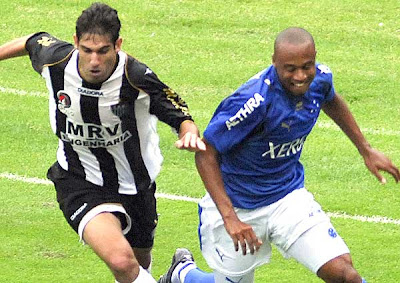

100 years ago this year, the Clube Atlético Mineiro, known simply as Atlético, or by its mascot Galo (Rooster), was formed here in Belo Horizonte (Mineiro is the adjective for this state, Minas Gerais). Originally, as was the case with any soccer—who are we kidding, football—club in Brazil at the time, Galo was a team of the elite, and subsequently only hired players that likewise came from an elite pedigree. I.e., no Afro-Brazilian players need apply. In the middle part of the 20th century, smaller clubs from the interior of Minas Gerais started hiring players from poorer backgrounds, many of whom were Afro-Brazilian, and many of whom were much better than their cake-eating counterparts. These smaller teams began to beat up on prestigious urban teams like Galo, and to save face Galo decided to change tactics. If you can’t beat ‘em, join ‘em. Since this time, Galo’s identity has shifted at the end of its century of existence to a team of the masses, a team of the poor, the favelados, those that live in favelas.

87 years ago this year, Galo’s rival, Cruzeiro Esporte Clube, known simply as Cruzeiro—or, to keep pace in the rhyming wars of the two teams’ songs, Zeiro—was formed by Italian entrepreneurs in Belo Horizonte. Cruzeiro has followed nearly the same path as Galo in terms of being a team of the elite in the beginning and incorporating poorer, Afro-Brazilian players near the middle of its lifetime—in fact, Brazilian national team hero-turned-has-been Ronaldo, who came from a poor family in Rio, played for Cruzeiro in the early 90s, starting at the tender age of 17. However, though today the team enjoys a following of both rich and poor—really, Galo has rich fans and poor fans alike as well—Cruzeiro has maintained, more or less, its image as a team of the elite, quite possibly in a way to preserve some uncommon ground to separate it from Galo. From an outsider’s perspective, whatever the line is that separates the identity of these two teams and their fans, it’s blurry at best.

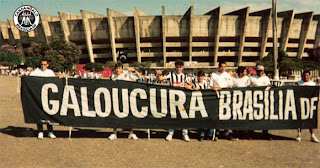
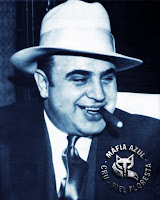
Each team has its run-of-the-mill fans, who follow their beloved club and detest their rival, but their fan-ship is all talk. At the extremes of each side lives the vanguard of each team’s fan base. For Atlético, it’s Galoucura, a contraction between Galo and Loucura (madness), thus meaning something like “Rooster Madness,” though our Hawk’s Nest would be something semantically closer, albeit not nearly as crazy. For Cruzeiro, not surprisingly due to the club’s Italian roots, there’s the Mafia Azul, the Blue Mafia (Cruzeiro’s colors are blue and white, Galo’s black and white). These fans on the fringe have their own organizations, their own shirts and pants that have a variety of slogans (one I saw for Mafia Azul said, “You either run with us or run from us – only God can judge us”), and images of their respective mascots in battle gear (I forgot to mention that Cruzeiro’s mascot is a fox—there are a lot of shirts with the image of a fox eating a rooster). Why battle gear? These groups have more hatred for each other than the average fans, and when given the chance their members won’t hesitate to take their natural Brazilian machismo one step further and beat the piss out of their rivals until they're dead or the police come and break up the fight.

All right, that should be sufficient background for the average Gringo to understand the craziness that is football in Brazil. Now let’s get to the game itself.

So Ricardo, the kid I live with from Vitória (I still need to tell his story), is a huge Cruzeiro fan. I came here neutral, but have since been baptized by this Mafia Azul commando-in-training as a Cruzeiro fan, albeit a mild one. Two weeks ago we went to a game between Cruzeiro and one of Minas Gerais’ small interior teams, Vila Nova. It was a brilliant game; Cruzeiro played terrible until the final 15 minutes of the game, coming back from 2-1 down to win the match 3-2 on a PK with 5 minutes to go. The game mattered little, however, and thus only about 10,000 or so fans showed up to the Mineirão stadium, which can comfortably hold 80,000, though has in the past seated—or rather stood—over 100,000. After this game, Ricardo was set on going to O Clássico to make up for such a rather tranquil match. I was leery. Everyone I’d talked to about O Clássico had told me how dangerous it was, how easy it would be to get caught in the crossfire between Galoucura and Mafia Azul. In the end, however, I made up my mind to go. A friend of a friend stood in line to get our tickets, which sold out in less than 8 hours. (As a side note, the tickets are CHEAP here! Student tickets cost 7.50 Reais, about $4.50, while general admission is still a mere 15 Reais, or 9 bucks. Put that in your pipe and smoke it, Gary Barta!) Ricardo and I, along with the grandson of Dona Dirce, Lucas, decided to take a bus from Coração Eurarístico to Pampulha, a wealthy neighborhood on the north side of the city where the guy who bought our tickets lived, which was conveniently a 10-minute walk from the Mineirão. This was a HUGE mistake. The three of us resolved to wear nothing at all having to do with Cruzeiro, which turned out to be the best decision any of us had ever made in our lives. As soon as the bus stopped at the southern edge of downtown, about 30 Galoucura members hopped on, and almost immediately began singing their war songs—dozens of them. Fans of both teams have pretty ugly chants they shout at one another. The Hawkeye creed that “I’d rather have a sister in a whorehouse than a brother at Iowa State” doesn’t even come close to the dirtiness—and, admittedly, creativity—of the mud these two sides hurl at each other. One of the cleanest and most popular, which both sides use equally (as I said, it’s a war of rhymes), goes “Ei, Galo/Zeiro, vai tomar no cu!” (“Hey, Galo/Zeiro, you’re going to take it in the ass!”) During the 45-minute bus ride to Pampulha, the three of us sat still and never even thought of making eye contact. Luckily, our silence in the midst of this maelstrom didn’t give away our allegiance.

Once we arrived in Pamulha, we chilled for a bit at the ticket-buyer’s house (I missed his name) and waited for some more friends to arrive. We ended up heading off to the Mineirão in a group of 9, which included two other Americans—the first I’d met since arriving here, who ended up being missionaries and friends of a friend of the ticket-buyer. Once again, we were lucky to have worn nothing Cruzeiro, or anything blue for that matter, as the route from the ticket-buyer’s house to the Mineirão took us right through the Galo “tailgate” as it were. Droves of crazy, drunk Atlético fans were getting away with as much mayhem as they could under the constant vigilance of the omnipresent Military Police, ready to break someone’s skull upon with their batons at a moment’s notice. We made our way to the Cruzeiro side of the stadium and, after being patted down by the MP, went in to find some seats. We were in the lower deck of the stadium and amid the throngs of fans we were lucky enough to find seats that gave us a pretty decent view of the field. I wish I could’ve brought my camera in to capture the scene we walked into. The Mineirão is more or less an oval. Behind one goal sits (again, read stands) the Galo fans, behind the other those for Cruzeiro. Along the sides of the oval, taking up about 4 whole sections on either end, is an empty buffer zone, home to only the MP and their German Shepherds. Absolutely no chances are taken that could result in all out war breaking out! For a good hour before the game, each side’s fans hurled slurs at each other as their teams warmed up on the field and innocent—and ignored—pairs of Galo and Cruzeiro fans marched around the field holding banners that read “Atlético and Cruzeiro: United for Peace” and “Cruzeiro and Atlético: United to Fight Tuberculosis.” Just before the opening whistle sounded, the upper deck on each side kept with tradition and unfurled their team’s enormous flags, showing the team logo and colors. To the humiliation of Galo fans and much to the delight of Cruzeirenses, the Galo side unfurled its flag upside-down, a HUGE disgrace to their team. Our group joked about how the people responsible for this atrocity would be killed. Sadly, though I don’t know of their fate, this could very well be more than a mere joke.

The game started with Cruzeiro on the attack early, keeping Atlético on its heals for the better part of the first ten minutes. From then on, the quality of offense on both sides dropped dramatically, making the rest of the game an ugly and anticlimactic defensive struggle. The game ended a 0-0 draw, with fans more hushed and disenchanted than I had first envisioned two weeks before. We scurried out as soon as the final whistle blew to beat the crowds. We chilled at the ticket-buyer’s house for a little bit before getting a ride back home, wanting more than anything not to repeat our bus fiasco from earlier that afternoon. On the way home we passed through Praça 7 de Setembro, a downtown square where Galoucura or Mafia Azul meet up after a victory to unofficially “claim” the city. Despite the marked MP presence, the praça was virtually devoid of hostile life.

This morning at school, fans from both sides wore their team colors with pride, each side believing that their team had played less ugly than the other. As I stood chatting with friends outside in the history and geography department courtyard, I watched as a student in a Galo jersey and another in a Cruzeiro jersey were about to cross paths. In a moment of rare Brazilian sportsmanship, instead of a sneer, instead of a verbal jab, instead of merely ignoring each other, the two fans smiled and cocked their heads back, giving each other a low-five as they each walked by the other. If even for a second, and albeit in the calming shade of palm trees in a well-off university campus, all was right in the football world of BH in that moment.

Correction to a Photo Below

A friend of mine here at PUC-Minas who has been following my blog told me that I got it wrong with this photo:Yes, there is class divide in Brazil. Yes, this divide can be seen in material juxtapositions almost everywhere you look. However, this photo is not one of them. The houses on the hill above the PUC library are not part of a favela, but rather a "middle-class" neighborhood. Favela, I have learned, is not a term that can be thrown around loosely at any conglomeration of multi-colored and capriciously built houses on a hill. Just goes to show that this Gringo has a lot yet to learn. Indeed, if I've learned anything after 5 weeks in this country, it's that this is a country that's always full of surprises.